What Happens When Anyone Can Launch a Perpetual Market on Hyperliquid But No One Can Guarantee Liquidity?
Hyperliquid started with a strong focus on crypto perpetual futures. Today, its market architecture is expanding into a much broader financial universe.
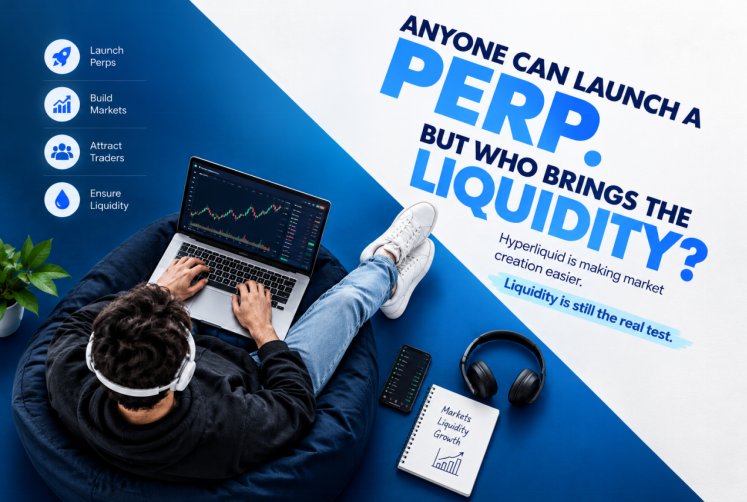
Imagine you have a great market idea.
A tokenized stock. Gold. Oil. An index. A niche commodity. Or an asset that traditional exchanges have never made easy to trade.
You can now ask a very different question than you could a few years ago:
“What if I could simply create a perpetual market for it?”
That is where Hyperliquid is changing the conversation.
With HIP-3, Hyperliquid introduced a permissionless framework that allows third-party builders to deploy perpetual markets using its existing trading infrastructure. Builders can define markets, manage oracles, configure leverage, and operate their own perpetual DEX environment.
And the market is responding.
As of August 23, 2026, HIP-3 markets represented approximately 48% of Hyperliquid’s 30-day trailing trading volume, with more than $514 billion in cumulative volume since launch.
But here is the question investors and builders should be asking:
If launching a market is becoming easier, who guarantees that people will actually trade it?
Because a market can be launched in minutes.
A liquid market is built over time.
Hyperliquid Is Moving Beyond Crypto-Native Perpetuals
Hyperliquid started with a strong focus on crypto perpetual futures. Today, its market architecture is expanding into a much broader financial universe.
Equities, commodities, indices, and other real-world asset-linked markets are increasingly appearing on-chain.
That shift matters.
Why?
Because investors are no longer looking only for another crypto token to trade. They are looking for exposure to familiar markets through new infrastructure.
Gold can be traded through a perpetual contract.
Equity exposure can move on-chain.
Commodity markets can become accessible through crypto-native trading infrastructure.
And the concept of tokenized real-world assets is moving from an experimental narrative toward an actual trading product.
Recent market activity illustrates how quickly this is developing. Hyperliquid's total open interest reached around $11 billion in July 2026, while RWA-linked open interest reached approximately $3.6 billion.
That creates an enormous opportunity.
But it also exposes an uncomfortable problem.
More markets do not automatically mean better markets.
The Real Challenge Is Not Listing an Asset. It Is Creating Liquidity.
Suppose a builder launches a perpetual market for a popular asset.
The interface looks polished.
The oracle works.
The smart contracts are deployed.
The market is technically live.
But there are only a few traders.
The order book is thin.
The spread is wide.
A relatively small order moves the price significantly.
Suddenly, the question changes from:
“Can we launch this market?”
to:
“Can traders enter and exit without paying a hidden liquidity tax?”
That distinction is critical.
Liquidity is what turns an available market into a usable market.
Without sufficient liquidity, traders face slippage. Market makers face greater inventory risk. Large investors may hesitate to enter. And eventually, trading volume can disappear.
This is why the next phase of Hyperliquid's growth may not simply be about how many markets can be created.
It may be about how many markets can develop sustainable liquidity.
HIP-3 Changes Who Can Create Markets
Traditionally, exchanges controlled which assets could be listed.
HIP-3 changes that model.
Hyperliquid's documentation describes HIP-3 as a key step toward decentralizing the perpetual market-listing process. Qualified deployers can create their own perpetual DEX environment, including independent margining, order books, and deployer settings.
That creates something powerful:
Market creation becomes programmable.
Instead of waiting for a centralized exchange to approve an asset, builders can create specialized markets around specific opportunities.
But permissionless infrastructure also means responsibility moves closer to the builder.
The deployer is responsible for important components such as market definitions and oracle configuration. HIP-3 also includes staking requirements, open-interest controls, and slashing mechanisms designed to protect market quality and network performance.
So the new opportunity comes with a new question:
When market creation becomes permissionless, does market responsibility become the real competitive advantage?
For serious builders, the answer is increasingly yes.
Why Liquidity Could Become the Biggest Competitive Moat ?
Think about two markets offering the same asset.
Market A has impressive branding, aggressive marketing, and thousands of users.
Market B has fewer users but deep order books, reliable pricing, efficient execution, and professional market-making support.
Where would a serious trader place a large position?
Probably Market B.
That is the difference between attention and market quality.
Volume can attract headlines.
Liquidity attracts serious capital.
And for institutional or high-value traders, execution quality can matter more than the number of markets available.
This is particularly important as Hyperliquid moves deeper into RWA perpetuals.
A crypto-native asset may trade continuously across several venues.
But a tokenized stock, commodity, or index introduces additional considerations:
● Where does the reference price come from?
● How reliable is the oracle?
● What happens when the underlying market is closed?
● How is abnormal volatility handled?
● What happens during extreme market conditions?
● How much open interest can the market safely support?
● Who provides liquidity when demand suddenly changes?
These aren't marketing questions.
They are infrastructure questions.
The Oracle Problem Is Bigger Than It Looks
A perpetual market is only as trustworthy as the price mechanism supporting it.
If the underlying asset has a deep, transparent market, price discovery is relatively straightforward.
But what happens when the underlying asset trades in different time zones, has limited liquidity, or becomes extremely volatile?
That is where oracle architecture becomes critical.
Hyperliquid explicitly warns that deployers should carefully consider oracle sources and edge cases because deployers carry responsibility for their listed markets.
For investors, this creates a simple but important question:
“Do I trust the market because the interface looks familiar or because the underlying price mechanism is resilient?”
The second answer is the one that matters.
RWA Perpetuals Could Be the Bigger Story
Crypto perpetuals proved that traders will use on-chain infrastructure for leveraged markets.
RWA perpetuals could test whether that behavior extends beyond crypto.
The attraction is obvious.
Imagine being able to trade exposure to major indices, commodities, or equities through a blockchain-native venue without using the traditional exchange infrastructure investors are accustomed to.
Hyperliquid's expansion into equity and commodity perpetuals shows how quickly this thesis is developing. The S&P 500, for example, has been brought into the ecosystem through an officially licensed perpetual product.
But this creates a much larger expectation.
If on-chain markets want to compete for serious global trading activity, they cannot simply replicate the asset.
They need to compete on:
execution.
liquidity.
risk management.
pricing.
reliability.
And eventually:
trust.
What Does This Mean for Builders?
For builders, the lesson is simple:
Don't build another market just because the infrastructure lets you. Build a market because traders have a reason to use it.
That changes the development strategy completely.
A serious perpetual platform needs more than a trading interface.
It needs market-making architecture, oracle infrastructure, liquidation mechanisms, risk controls, order-book design, collateral management, and reliable data feeds.
This is where the broader decentralized exchange development landscape is evolving.
The focus is shifting from simply creating a DEX to engineering a financial market that can withstand real trading activity.
And Hyperliquid provides an interesting example of where that development model could go next: infrastructure becomes increasingly modular, while the quality of the market becomes the builder's responsibility.
So, What Happens When Anyone Can Launch a Perpetual Market?
The answer may be surprisingly simple.
More markets will be created.
But only some will become meaningful markets.
HIP-3 lowers the barriers to creating perpetual markets, and the resulting growth already shows that builders and traders are willing to experiment with new asset categories.
The next battle, however, may be much harder.
It will be about who can create deep liquidity, reliable price discovery and sustainable trading demand.
Because investors don't ultimately care whether a market can be launched.
They care whether they can enter, trade, manage risk, and exit efficiently.
And that leads us back to the question that matters most:
What happens when anyone can launch a perpetual market on Hyperliquid but no one can guarantee liquidity?
Maybe the next generation of winners won't be the builders who launch the most markets.
Maybe they'll be the ones who make those markets worth trading.
The future of on-chain markets may not be measured by how many assets are listed.
It may be measured by how much real liquidity stands behind them.
What's Your Reaction?