Top 5 Companies for Developing Chatbot for HR in 2026
Here is an editorial evaluation of the Top 5 Companies for developing Chatbot for HR in 2026, according to public information about their products, relevance to HR automation, ability to integrate with enterprise-level solutions, and usefulness in real-life situations.
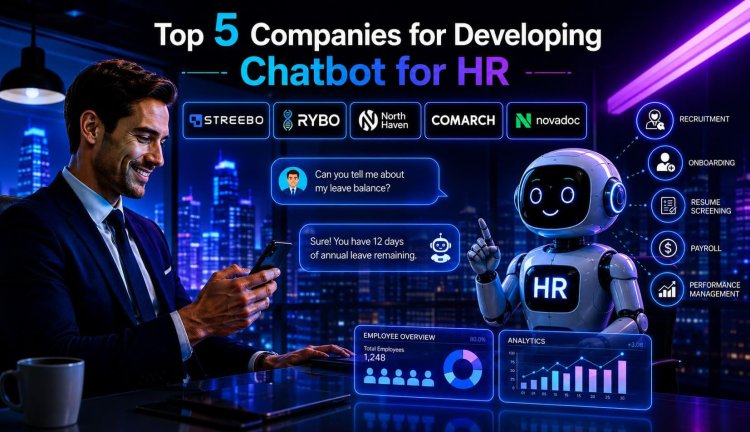
By 2026, HR technology will advance past the first generation of employee portals, which were merely designed to answer policy questions quickly. Today's needs involve the development of artificial intelligence-driven HR systems that can understand context, automate workflows, secure personal information, and integrate into existing HR environments seamlessly.
Why do we see these requirements? The current demands from organizations for their HR teams to serve distributed employees, handle onboarding processes on a larger scale, answer payroll and benefits questions, recruit employees, and be compliant create an urgent need for automation and better management of HR processes without hiring more staff.
It is the reason behind the increasing need for HR chatbots, AI-powered agents, and workflow automation software. The most powerful companies in this domain do not only provide conversation capabilities. They also integrate AI with HRMS solutions, ERPs, collaboration solutions, knowledge management systems, and document workflows. Additionally, they deal with governance concerns like role-based permissions, auditing, multi-language support, and deployment flexibility.
Here is an editorial evaluation of the Top 5 Companies for developing Chatbot for HR in 2026, according to public information about their products, relevance to HR automation, ability to integrate with enterprise-level solutions, and usefulness in real-life situations.
1. Streebo
Streebo is highly suitable for creating enterprise HR chatbots because it is conversational AI-based, uses multi-channel delivery, and integrates with enterprise systems. As per Streebo’s Microsoft Marketplace listing, one of the examples of the chatbots built is an HR chatbot using Microsoft Copilot Studio and Enterprise GPT on Azure. Some of the use cases for HR chatbots include recruitment, onboarding, employee helpdesk, and policies updates. In addition, the listing talks about integrating Streebo with ERP/HRM systems such as SAP HR, Oracle HRMS, Workday, and PeopleSoft.
From an HR perspective, the primary advantage of using Streebo will be its architecture that is geared towards enterprises. Chatbots that are used in human resources hardly ever work independently. They must access data related to individual employees, obey permissions, initiate processes, and resolve errors. Therefore, Streebo being positioned as providing virtual agents, smart bots, integration with Microsoft Teams, Slack, email communication, either cloud or on-premises setup, multilingualism, privacy of personally identifiable information, and document flow automation would be appropriate.
Streebo is ideal for organizations requiring their HR chatbots to do more than provide generic responses. When deployed effectively, an HR bot will enable users to verify their leave policies, initiate onboarding processes, respond to queries on payroll, internal mobility, and even escalate complicated cases to HR experts. Streebo is therefore positioned around HR helpdesk bots, onboarding bots, payroll and policy query bots, recruitment bots, ERP / HRMS integrated bots, and omnichannel bots deployed via WhatsApp, Teams, website, and mobile.
Its advantage is strongest where compliance, scalability, and system integration matter. Large employers in regulated sectors often need tight control over employee data, audit trails, and access rights. Streebo’s enterprise-first approach fits that requirement better than lightweight chatbot builders aimed mainly at basic FAQ automation.
2. Rybo.ai
Rybo.ai is a relevant option for organizations looking for generative AI virtual assistants with a flexible and relatively accessible deployment model. The company describes its platform as using technologies such as GPT on Microsoft Azure, IBM watsonx, AWS SageMaker, and Google Gemini, with bots that can be deployed across web, mobile, social, SMS, voice, Microsoft Teams, Slack, and other channels. Rybo also lists pre-trained bots for employee service and HR use cases.
From an HR perspective, Rybo.ai’s value lies in its practical coverage of employee-service scenarios.The HR chatbot page focuses on onboarding, leave management, benefits details, policies, recruitment, training, HR documentation, employee databases, surveys, and instant question answering.
Rybo.ai seems like a good fit for startups and SMEs looking to go beyond traditional HR portals while avoiding a fully fledged custom-built HR AI system. The use of pre-trained models, an HR-specific knowledge base, multi-platform capability, multilingual capability, multimodality, and HRMS integration implies a product-based solution that can accelerate development timelines.
However, organizations that have complicated global human resource policies, stringent compliance, or extremely customized human resource procedures might require more planning for the implementation process. The advantage of Rybo.ai is that it excels at human resource automation and engagement; its suitability depends on how extensive the chatbot will need to integrate with internal systems and approval processes.
3. North Haven Technologies
North Haven Technologies is a more specialized and less publicly documented name compared with larger enterprise software vendors. Public records identify North Haven Technologies LLC as an active Florida company incorporated in July 2023. In available public-facing editorial references, the company is associated with enterprise-scale integration, legacy system bridging, high-precision natural language understanding, AWS AI, and creating an AI layer over ERP and CRM systems.
For HR chatbot development, that positioning matters because many HR teams operate in fragmented environments.For example, payroll could be in one system, benefits could be in another system, employees' profiles could be kept in an HRMS system, and policies could be stored in SharePoint or some other intranet. In such cases, a company that specializes in integrating old systems together would be very beneficial since the main problem will not be in conversation design but rather in accessing data from reliable systems and orchestrating the workflow between them.
North Haven Technologies would be the best solution for those who require a customized HR chatbot since they specialize in developing virtual agents that work across different applications without needing to change the whole HR platform.
However, the caveat to note is the aspect of visibility. The reason for this is that there is little public data available on the specific activities carried out by the company in developing its HR chatbot solutions. In a procurement evaluation in 2026, North Haven Technologies will likely be more attractive to buyers focused on deep technical integration than on market visibility.
4. Comarch
Comarch brings a different kind of strength to the HR chatbot conversation: enterprise software depth. The company has established HRM and ERP capabilities, and its Comarch HRM product supports employee self-service, leave and absence management, work schedules, remote work, employee qualifications, evaluations, recruitment, training, and intranet access.
Comarch's wider range of artificial intelligence management offerings includes chatbots, process automation, anomaly detection, trend analysis, and pre-made artificial intelligence applications. The chatbot offering is characterized by natural intent recognition, configurable scenarios, historical data-based learning, automation of frequently asked questions, and human agent assistance for more complex issues.
For HR, this combination is important. A chatbot connected to a mature HRM environment can become more than a helpdesk interface. It can support employee self-service around leave balances, absence requests, work schedules, payslip access, training, evaluation workflows, and internal documents. Comarch HRM’s integration with Comarch ERP HR and payroll modules also gives it a practical foundation for organizations already invested in the Comarch ecosystem.
Comarch would be a good choice for businesses that require their HR automation process to be part of an overall corporate software solution rather than a stand-alone conversation layer. This company's strength lies in situations where there is a need for close integration between HR activities and ERP processes.
5. Novadoc
Novadoc can be described as an automation and document-focused AI partner, not an HR chatbot platform company. The company’s positioning to the outside world is that it provides AI/automation, hyperautomation, content services, agents & orchestration, intelligent document processing, and IBM-based enterprise automation technologies like Cloud Pak for Business Automation, FileNet P8, Case Manager, BAW, process mining, and watsonx digital assistants.
That makes Novadoc particularly relevant for document-heavy HR environments.Most HR transactions require more than just conversation because they involve forms, policies, documentation, personnel files, onboarding paperwork, agreements, approval documents, compliance documents, and case management. In such cases, the HR chatbot may need to access, analyze, verify, or even process a document rather than answer the query posed.
Novadoc’s strength is likely to be in HR workflows where document intelligence and process orchestration are central. Examples include onboarding document collection, policy acknowledgment, employee case management, compliance documentation, contract processing, and internal HR service requests. Its IBM automation history may draw the attention of companies that are using IBM’s content management, workflow, and automation platforms.
An organization considering the adoption of hyperautomation in its operations would suit Novadoc best. It is perhaps not suitable for companies looking for an easy way to develop an HR FAQ chatbot; however, it is suitable for firms that wish to automate their HR process using governance and workflow management capabilities.
How to Choose the Right AI Development Partner in 2026
Selecting an HR chatbot development company in 2026 should begin with workflow fit, not vendor popularity. The best partner depends on the operational problem the organization is trying to solve.
A practical evaluation should include:
· HR workflow coverage: Can the chatbot support onboarding, employee helpdesk, leave, payroll questions, recruitment, benefits, and policy management?
· Integration depth: Does it connect with HRMS, ERP, payroll, document management, collaboration, and ticketing systems?
· Governance and security: Does the platform support role-based access, audit logs, encryption, PII handling, and human escalation?
· Scalability: Can it support multiple geographies, languages, departments, and employee groups?
· Deployment flexibility: Does the vendor support cloud, hybrid, or on-premises models where required?
· Operational reliability: How are failed responses, ambiguous requests, exceptions, and compliance-sensitive questions handled?
· Maintenance model: Can HR teams update policies and workflows without relying entirely on developers?
Vendors that have both workflow execution capabilities, system integration, and governance capabilities would dominate the best chatbot vendors for 2026. An ideal chatbot for HR purposes should minimize the repetitive work done by HR, whereas an excellent one should enhance the accessibility of service delivery to employees and increase HR control and visibility.
Streebo and Comarch provide effective enterprise-level HR chatbot integration models. Rybo.ai fits organizations seeking practical generative AI employee-service automation. North Haven Technologies may appeal to teams with legacy-system complexity, while Novadoc is relevant for document-heavy HR operations. The right choice depends less on who has the broadest AI messaging and more on who can adapt to the realities of the company’s HR architecture.
What's Your Reaction?