How AI Is Reshaping Software Development Workflows: An Inside Look at the Process Shift
A lot of organizations end up working with a custom software development company specifically to integrate AI responsibly instead of bolting it on piecemeal.
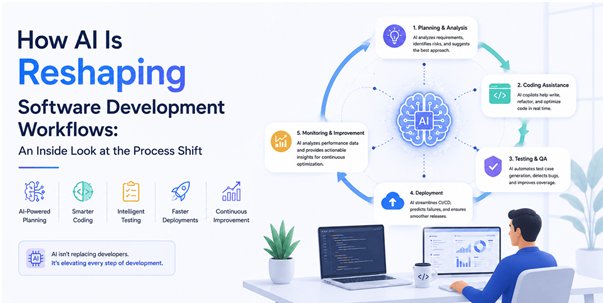
Several years ago, the term "AI-powered code editor" simply implied an application that completes your sentences for you. It is not the case today. Artificial intelligence technology in software development has affected every aspect, including planning, coding, testing, and deployment, and has impacted how engineering teams spend their real-life hours. With less time spent on boring tasks that require no creativity, there is more time left for solving actual architectural, business, and logical problems that do require human involvement.
The statistics prove this statement: the Stack Overflow's 2025 Developer Survey reports that 84% of developers already use or are going to use AI technologies, compared to 76% from the previous year.
So here's a walk through where AI in software development is actually showing up across the engineering lifecycle, what it does to a developer's day-to-day role, and where a human still has to be the one making the call.
Software Development Has Moved Beyond Traditional Coding
The traditional SDLC process had been very straightforward. Collect the requirements, code the solution, test it, and maintain/deploy it. All the steps were manual, and getting from one step to another was only time-consuming.
The traditional process is outdated, however. In the old days, collecting the requirements meant drafting long documents by hand. Now, the team drafts an initial version using AI and devotes its efforts to polishing this draft rather than producing it from scratch. In the past, coding was always done manually, line by line. Today, the development becomes partially automated, with a portion of boilerplate being generated automatically, and with the developers' role becoming more related to reviewing and shaping this output. The testing used to involve manual creation of test cases. Many of these tests are performed automatically today, with regression tests working silently in the background. Even the deployment process has changed, with monitoring shifting towards AI identifying issues worthy of attention rather than a person spending an hour looking through logs.
Where AI Is Changing the Development Lifecycle
Planning & Requirement Analysis
Teams use AI to draft user stories, put together early documentation, and estimate feature scope faster than doing it by hand ever allowed. This is usually the earliest place AI in software development shows up in a project, before anyone's touched a line of code. It doesn't replace product judgment. It just means nobody's staring at a blank page for as long.
Coding Assistance
This is the part everyone notices first. GitHub Copilot, Cursor, Claude Code, and Amazon Q Developer all live right inside the editor now, cranking out boilerplate, offering autocomplete, and speeding up prototyping in a way that would've sounded like science fiction a decade ago. For a team exploring modern engineering practices, this is usually where AI adoption starts, and honestly, it's the easiest place to start.
AI Code Review
AI code review tools catch bugs, flag security issues, and check style consistency before a human reviewer even opens the pull request. A lot of them suggest refactors too, which cuts down the back-and-forth that used to eat up half a review cycle.
Testing & QA
QA is one of the places AI automation has really taken hold. Generating test cases, running regression tests, catching edge cases a tired human tester might miss at 5pm on a Friday. None of that removes the need for an actual QA strategy. It just means more ground gets covered in less time.
Deployment & Monitoring
Once something's live, AI tools help with log analysis, performance monitoring, and tracking down root causes faster than a person digging through logs manually. Some teams are even catching incidents before they hit users, through early prediction rather than after-the-fact cleanup.
How AI Changes the Role of Software Engineers
This is the part that gets talked about the least, but it's probably the biggest deal. AI-assisted software engineering isn't taking developers' jobs. It's changing what fills their day. Engineers spend more time now on architecture, business logic, security, system design, and the user-experience calls that still need a person paying attention. The routine stuff keeps shrinking. The stuff that actually needs expertise keeps growing.
Benefits Organizations Are Already Seeing
● Faster development cycles from planning through deployment
● Better code quality when AI review gets paired with an actual human checking it
● Less time spent on repetitive, low-value coding work
● Better collaboration through shared, AI-assisted documentation
● Faster onboarding for new engineers joining an existing codebase
● Higher developer productivity overall
● Documentation that stays more current instead of going stale
Challenges That Still Require Human Expertise
None of this is a clean win, and pretending otherwise is how teams get burned.
Hallucinated Code and Reliability Gaps
Code that looks right but references logic that doesn't actually exist is still a real problem. It's one of the easiest ways for AI output to pass a quick glance and fail the moment someone actually runs it.
Security and Licensing Risk
Security holes and licensing issues can slip through if nobody reviews AI output carefully. AI tools also still miss the bigger picture of a codebase, which is exactly how small gaps turn into real vulnerabilities down the line.
Technical Debt from Unreviewed Code
Code nobody reviews properly quietly turns into technical debt instead of avoiding it. The speed AI offers only pays off if someone's actually checking what gets shipped.
Compliance and the Case for Human Review
In compliance-heavy industries, human review isn't optional, it's the whole point. A lot of organizations end up working with a custom software development company specifically to integrate AI responsibly instead of bolting it on piecemeal.
What Comes Next?
Agentic AI and Self-Correcting Pipelines
The next stretch looks like agentic AI taking on more autonomous testing and monitoring, along with DevOps pipelines that self-correct without waiting for a human to notice something's wrong.
Multi-Agent Development
Multi-agent setups are starting to show up too, where a few AI systems split up parts of a build at once instead of one model handling everything sequentially.
Generative AI as a Collaborator
Generative AI development is drifting from "helpful add-on" toward something closer to an actual collaborator, though someone still has to hold the map.
Conclusion
AI in software development is worming its way into nearly every stage of the engineering process, and it's not replacing developers so much as it's letting AI-assisted software engineering do more of the heavy lifting. The teams pulling ahead here are the ones pairing human judgment with AI on purpose, not handing decisions off wholesale, and they're shipping faster without letting quality or governance slide. If you're an engineering leader trying to figure out how far to take AI adoption, that balance is really the whole ballgame. It's a harder problem than the tools themselves.
Author Bio
Priyanka Sharma is a Software Professional at CodeAegis Pvt. Ltd. with over eight years of experience in software development. Throughout her career, she has contributed to building scalable, reliable, and high-performance applications across diverse industries. Along with her technical expertise, Priyanka is passionate about creating insightful content that simplifies complex technology topics. Drawing from her real-world experience, she shares practical knowledge, emerging industry trends, and best practices to help businesses, developers, and technology enthusiasts make informed decisions in an ever-evolving digital landscape.
What's Your Reaction?