The Mechanical Stirrer: The Underappreciated Equipment for Laboratory Mixing Processes
Bionics Scientific is a laboratory overhead stirrer manufacturer in India, offering powerful mechanical stirring systems for mixing liquids in laboratories, research facilities and industrial applications.
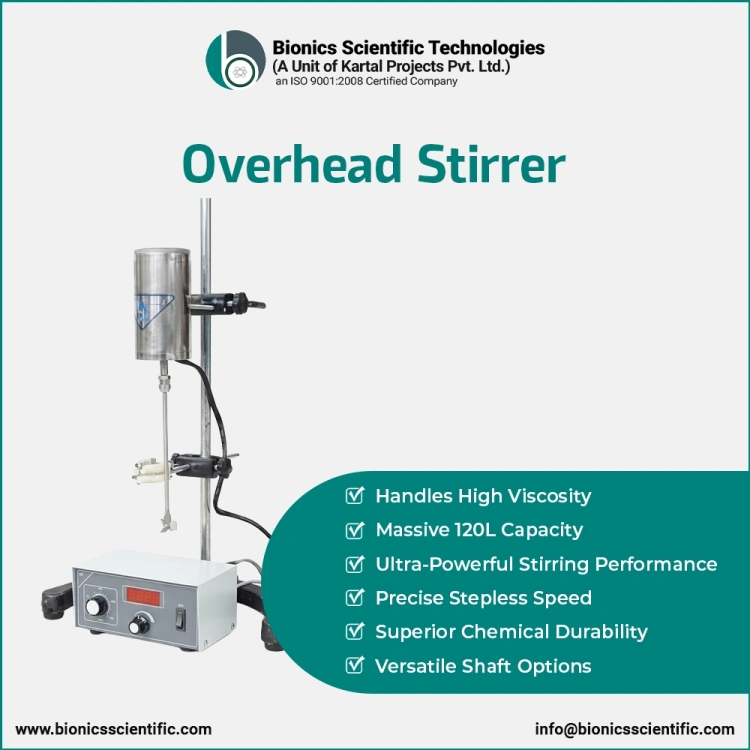
In any lab, there is always equipment that does not get the limelight but continues to function in the background. One such piece of equipment is the mechanical stirrer. Though not as attractive as the analytical balance or as accurate as the spectrophotometer, each chemist, formulator, or quality controller would testify as to its indispensability in their process.
Functions of the Mechanical Stirrer
A mechanical stirrer is basically a device that blends or mixes liquids and suspensions using a rotational shaft powered by a motor. The shaft rotates an impeller or paddle that helps stir the liquid in the mixture. Unlike the simple magnetic stirrer that requires a stir bar and magnetic stirrer, the mechanical stirrer can cope with large quantities of liquids, high viscosity and even complex mixing processes and hence is the most suitable when it comes to long duration mixing.
Its operation is quite simple; a motor drives a shaft inside the liquid to be stirred and the blade at the end makes sure that there is proper mixing.
Stirring using Mechanical Stirrers and Simple Stirring and Magnetic Stirring Techniques
The simple or manual stirring works very well for small volumes of low viscosity solutions. On the other hand, when large volume or high viscosity solutions are considered, it fails. This problem can be resolved by applying mechanical stirring since it gives torque and speed control which helps keep the process of mixing constant whatever the case, either thick suspensions and emulsions or large volumes of solutions. Therefore, mechanical stirrers are applied in areas like production of polymers, paints and coatings, pharmaceutical suspensions etc.
Another benefit of mechanical stirrers is that of precision of performance. High quality mechanical stirrers give digital speed control, torque control and timer feature.
Types of Mechanical Stirring Devices Used in Laboratories
Overhead mechanical stirrers are the most common type where the stirring device is located above the container, and its shaft goes into the liquid substance within the container. The other types of mechanical stirrers are heavy duty types for larger batches in pilot or industrial production and explosion-proof types for laboratory use in cases when the mixture involves flammable substances because an ordinary electric motor may be not safe in this case. The choice of the type of mechanical stirrer will depend on the volume of the batch, the viscosity of the substance and chemicals to be mixed.
Application of Mechanical Stirrers in Industries
The use of mechanical stirrers is widespread in laboratories where chemical synthesis takes place, in pharmaceutical and cosmetics industries, in the food and beverages sector and in the research labs. In cases when the process involves the constant mixing rather than just blending of ingredients, the use of such equipment is unavoidable.
Before Making Purchase
If you need a mechanical stirrer, then be sure to consider such features as the torque output depending on the viscosity of the sample you use, the accuracy of digital control, longevity of the motor under intensive operation, and compatibility with different types of paddles/impellers. The importance of noise and vibration levels will exceed your expectations when doing long-term stirring in a shared laboratory environment.
Our Mechanical Stirrers from Bionics Scientific can resist the daily demands of laboratories in terms of durability, torque output stability, and precision.
Conclusion
A mechanical stirrer is rather an ordinary equipment to place on your workbench. However, it is a reason why your experiments are always accurate.
FAQ – Magnetic Stirrers with or without Hot Plate
1. What is a magnetic stirrer?
A magnetic stirrer is a laboratory instrument used to mix liquid samples continuously and uniformly. It uses a rotating magnetic field to spin a magnetic stir bar placed inside the container, providing efficient and consistent stirring without manual mixing.
2. What is the difference between a magnetic stirrer with and without a hot plate?
A magnetic stirrer without a hot plate is primarily designed for mixing and stirring liquid samples. A magnetic stirrer with a hot plate combines stirring and controlled heating in one instrument, making it suitable for applications where a sample needs to be mixed and heated simultaneously.
3. What are magnetic stirrers with hot plates used for?
Magnetic stirrers with hot plates are commonly used for laboratory sample preparation, chemical reactions, dissolving substances, solution preparation and other applications that require controlled stirring along with heating.
4. What are magnetic stirrers without hot plates used for?
Magnetic stirrers without hot plates are suitable when only mixing is required. They can be used for preparing solutions, maintaining uniformity in liquid samples and carrying out laboratory procedures where heating is not necessary.
5. How does a magnetic stirrer work?
A magnetic stirrer generates a rotating magnetic field beneath the vessel. This magnetic field causes a small stir bar inside the liquid to rotate, creating a controlled stirring motion and helping produce a homogeneous solution.
6. What factors should I consider when choosing a magnetic stirrer?
Important factors include stirring capacity, speed range, temperature requirements, hot-plate material, temperature control, sample volume, operating environment and the type of laboratory application. Choosing the right model depends on the specific requirements of the experiment or process.
7. Can a magnetic stirrer with a hot plate control temperature?
Many hot-plate magnetic stirrer models provide adjustable temperature control. Depending on the model, temperature can be monitored or controlled using an integrated system or an external temperature probe.
8. Are magnetic stirrers suitable for different laboratory applications?
Yes. Magnetic stirrers are widely used in research laboratories, educational institutions, pharmaceutical laboratories, chemical testing, biotechnology and other scientific applications where consistent liquid mixing is required.
9. What is a magnetic stir bar?
A magnetic stir bar is a small magnetically responsive bar placed inside the liquid container. When the magnetic stirrer creates a rotating magnetic field, the stir bar rotates and mixes the liquid.
10. How do I select the right stir bar for a magnetic stirrer?
The stir bar should be selected according to the vessel size, liquid volume, sample characteristics and required stirring performance. Common shapes and sizes are available for different laboratory applications.
11. Can magnetic stirrers be used for viscous liquids?
Magnetic stirrers can handle many low- to moderate-viscosity liquids, but performance depends on the instrument's motor, stirring capacity, sample volume and viscosity. Highly viscous materials may require a different type of laboratory mixer.
12. What are the advantages of using a magnetic stirrer?
Magnetic stirrers provide consistent and hands-free mixing, help maintain uniform solutions and can offer precise control over stirring speed. Models with hot plates also combine heating and stirring in a single laboratory instrument.
13. Are magnetic stirrers easy to operate?
Yes. Most magnetic stirrers are designed with straightforward controls for adjusting stirring speed and, in hot-plate models, heating parameters. However, users should always follow the manufacturer's operating and safety instructions.
14. How should a magnetic stirrer be maintained?
Keep the instrument clean and dry, inspect the stirring surface and controls regularly, and avoid spilling chemicals onto the equipment. For hot-plate models, allow the surface to cool before cleaning and follow the manufacturer's maintenance recommendations.
15. How can I choose between a magnetic stirrer with or without a hot plate?
Choose a magnetic stirrer without a hot plate when your application requires only mixing. Choose a magnetic stirrer with a hot plate when you need both controlled heating and stirring in the same laboratory setup. Your sample type, temperature requirements and experimental procedure should guide the selection.
What's Your Reaction?