Ointment Manufacturing Plant: From the Raw Materials to the Final Product in the Tube
Spend one hour on the factory floor in an appropriately designed ointment manufacturing plant and there is one thing you will soon realize.
Why Is an Ointment Manufacturing Plant Much More Than a Simple Large-Scale Mixer?
Spend one hour on the factory floor in an appropriately designed ointment manufacturing plant and there is one thing you will soon realize. There is no room for errors. Everything is done under controlled temperatures, pressures, and transfers so as to avoid contamination of the product. The outcome is a stable semi-solid product which is easy to apply and gives you the right dosage in each tube. Over the years I have noticed that those who understand the whole process design better facilities.
Steps in Manufacturing
Two Phases Preparation
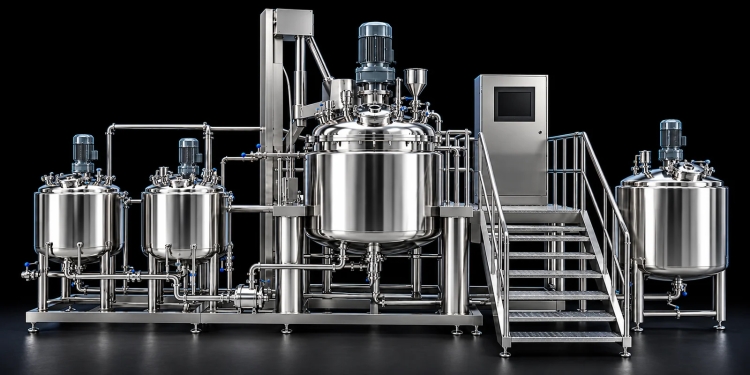
As it has already been mentioned above, most of ointments and creams are emulsions. Therefore, manufacturing of the drug will begin with the preparation of two phases, where the first one will include oils and waxes, fatty alcohols, and petrolatum. It is heated in jacketed vessel, while the second phase, which includes purified water, humectants, and preservatives, is heated in another vessel. Heating of both phases will help them to mix.
Vacuum Emulsification
Both phases are mixed in the main vessel in vacuum. In the main vessel there is homogenizer and slowly rotating scraper agitator. Homogenizer breaks up the droplets into small pieces, and scraper is responsible for the movement of material from the wall. Vacuum will help to extract all the air from the mixture and prevent the bubbles and oxidizing.
Cooling, Additions of Active Ingredients and Transfer
After forming of the emulsion, cooling takes place in the jacket of the vessel. The active ingredients, fragrances, and certain preservatives are introduced to the mix during the process of cooling, which ensures that these substances are not destroyed in the process of mixing. Finally, the batch of the product is transferred to the storage tank using pump or vacuum.
Important Areas of the Plant
Manufacturing and Filling Areas
Manufacturing and filling areas have to be separated from the areas of storage and packaging of raw materials by smooth walls, enclosed floors and air flow control. The personnel has to be required to change clothes in changing rooms, while materials have to pass only one way to prevent contamination of raw and processed materials.
Utilities and Cleaning
The process of ointments manufacturing at the pharmaceutical factory involves steam/hot water, cooling water, purified water, compressed air and electricity. Planning of cleaning is essential. Sanitary pipelines, short conveyances and smooth tanks are very useful for cleaning.
Operators' Problem and How to Prevent Them
Product having grainy texture is a consequence of insufficient cooling or uneven cooling of the waxes. Insufficient mixing or wrong temperature of the phases causes phase separation. Appearance of bubbles means that there was insufficient vacuum and incorrect mixing rate. When product sticks to the vessel walls, then the problem is associated with scrapers, they are old or wrongly positioned.
Regulatory and Quality Problem
Ointments that are used in the pharmaceuticals should be produced in India according to GMP, which can be beneficial also for cosmetic industry. Don't forget about updating your batch, equipment and cleaning logbook. It is important to calibrate your gauges and sensors in due time and ask for materials and equipment qualification from the supplier.
Establishing a Manufacturing Plant for Ointments
Once you identify the products that you wish to manufacture, the next step is to establish the size of your batches, the machine required and the space. Ensure that you have the capacity to deal with expansion due to sudden increase in demand. Stainless steel 316 or 316L should be used in fabrication of your machine and it should be able to be disassembled.
Conclusion
Manufacturing plants for ointments should have good manufacturing process and cleaning process.
What's Your Reaction?