Portable Laser Leaf Area Meter: Testing it, Debugging it, and Producing Publishable Results
A portable laser-leaf-area meter is an advanced scientific device that can measure accurately leaf area, leaf length, leaf width, and leaf perimeter.
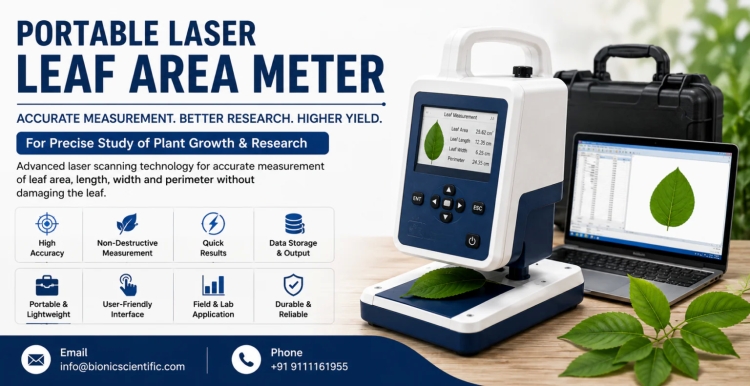
The purchase of the portable laser leaf area meter is not a complicated process. One difference between successful researchers and aspiring researchers is being able to ensure the accuracy of your results. There is no point in seeing some number on the screen if you do not know whether it is true for your plant and its leaves. The guide assumes you have basic knowledge of it.
Validating Your Hand-held Laser Leaf Area Meter Prior to Testing
Set aside an afternoon for validation prior to your testing. Determine a figure with a known leaf area, like a card that is cut to size and printed with a known leaf area, and check whether the reading is within the tolerance of the device. Measure 20 leaves from your own crop using the meter and then determine the values using another method like the flat bed scanner or the gravimetric method. If the results agree, then you have something to write in your methods section. If not, you have gained something without losing a growing season.
Problematic Leaves
Some leaves may be problematic. The narrow cereal blade will go through your scanner guides; thus, cut it into small pieces or use the holders included. The rolled maize leaves should be carefully unrolled but not stretched since stretching alters its surface area. In the case of furry, waxy or shiny leaves, many trials are necessary to determine their real values. In the case of compound leaves, a procedure should be set and used throughout.
Field Troubleshooting Tips
If you have inconsistent measurements during rescan on the same leaf, it may be due to wind, dirty scanning window or leaf is not laying flat. Consistently low readings mean that your scanner did not capture the entire leaf because of overlap or curling leaf edges. Uncontrolled drift during a single scanning process is mostly caused by low battery charge or overheating of the device, especially after exposure to direct sunlight. Do not expose your device to sunlight; shade it and recalibrate it during the mid-day. Keep your correction notes short but consistent.
Converting Your Measurements into Useful Data
An accurate measurement is not useful without the right context. Label all your measurements using plant identification number, treatment, development stage and leaf position. Take advantage of the internal memory feature and export your data in the CSV format and not in hand written form since transcription errors are the most common problems in collecting leaf area data. You can then calculate the leaf area index, specific leaf area and relative growth rate. Make sure you have enough sample size per treatment and do not forget that an accurate measuring device does not eliminate poor sampling methods.
Does It Make Sense to Purchase a Mobile Laser Leaf Area Meter?
Consider what you are getting. Non-destructive measuring technology means that you will be able to revisit the tagged leaf at any moment throughout the season and have growth curves instead of single readings. Moreover, you are saving your plants from being killed during the
process of measurements. And this point is especially relevant for a breeding plot, which has a scarce amount of plants available.
Conclusion
In order to utilize a laser leaf area meter to its fullest, it is necessary to validate it, understand its limitations, and write down your observations. Test it on your own crops, set up your own protocols, and contact your vendor for calibration and support prior to purchasing the product.
What's Your Reaction?