DramaBox Clone vs Custom Development: Which Is Better for New Micro Drama Businesses?
They launch with a DramaBox clone framework to enter the market quickly, then gradually introduce custom features based on user feedback and business growth.
The rapid growth of micro drama platforms has created exciting opportunities for startups, media companies, OTT entrepreneurs, and content studios. Mobile-first audiences are increasingly consuming short-form episodic content, making vertical storytelling one of the most promising entertainment business models in recent years.
As businesses evaluate this market opportunity, one important decision arises early in the planning process:
Should you build a completely custom platform or launch using a DramaBox-inspired framework?
This decision affects development timelines, investment requirements, scalability, monetization speed, and overall business risk.
Many founders assume that custom development is automatically the better option because it offers complete control. While that may be true in certain situations, it is not always the most practical approach for businesses entering a rapidly evolving market.
Understanding the strengths and limitations of both approaches helps entrepreneurs make more informed decisions based on their goals, resources, and growth strategy.
Why This Decision Matters More Than Ever
The micro drama industry is becoming increasingly competitive.
New platforms are entering the market regularly, audience expectations are rising, and content acquisition costs continue to increase.
At the same time, businesses face pressure to:
● Launch quickly
● Validate demand early
● Generate revenue faster
● Optimize marketing investments
● Scale efficiently
Choosing the wrong development strategy can delay growth and increase operational risks.
The goal should not simply be to build a platform.
The goal should be to build a sustainable micro drama business.
Understanding Custom Development
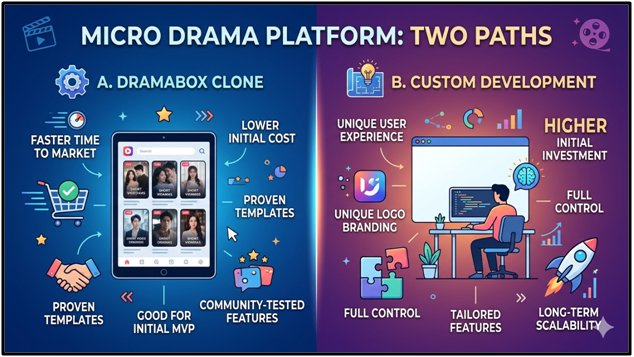
Custom development involves building every component of the platform from scratch.
This approach allows businesses to create a fully unique ecosystem tailored to their specific requirements.
A custom-built platform typically includes:
● Mobile applications
● Backend infrastructure
● Streaming systems
● User management
● Content management
● Monetization tools
● Analytics dashboards
● Recommendation engines
Everything is designed specifically for the business.
This level of flexibility is appealing to founders who have highly unique requirements or long-term product visions.
However, custom development comes with significant responsibilities.
Advantages of Custom Development
Custom development offers several benefits.
Complete Product Control
Businesses can define every feature according to their vision.
There are no limitations imposed by existing frameworks.
Unique User Experiences
Companies can create highly differentiated interfaces and engagement systems.
This can become a competitive advantage if executed effectively.
Flexible Future Expansion
Custom platforms can be designed around long-term scalability goals and future feature requirements.
This may reduce limitations later as the platform evolves.
Strong Technology Ownership
Businesses maintain complete ownership over the product architecture and development roadmap.
For some companies, this level of control is strategically important.
Challenges of Custom Development
While the advantages are attractive, many startups underestimate the challenges involved.
Longer Development Timelines
Building every component from scratch requires extensive planning, engineering, testing, and optimization.
Development timelines can extend for many months before a platform becomes market-ready.
During this period, competitors continue growing and capturing audiences.
Higher Upfront Investment
Custom development often requires larger budgets due to:
● Engineering resources
● Product design
● Infrastructure setup
● Quality assurance
● Continuous testing
This can create financial pressure before revenue generation begins.
Increased Technical Risk
Every custom platform introduces new technical uncertainties.
Businesses must solve challenges related to:
● Video streaming
● Scalability
● Performance optimization
● Security
● Monetization systems
Unexpected delays are common in large software projects.
Understanding a DramaBox Clone Approach
A DramaBox clone provides businesses with a proven framework designed specifically for micro drama platforms.
Rather than starting from zero, companies begin with an established foundation containing many of the features required for launch.
This approach focuses on customization rather than reinvention.
Businesses can modify branding, workflows, monetization models, and user experiences while leveraging existing platform architecture.
The result is a significantly faster path to market.
Advantages of a DramaBox Clone
For many new businesses, a clone-based approach offers practical benefits.
Faster Time-to-Market
One of the biggest advantages is launch speed.
Core platform features are already available, reducing development requirements significantly.
This allows businesses to focus on:
● Content acquisition
● Audience growth
● Marketing campaigns
● Revenue generation
Instead of spending months building infrastructure, they can begin testing market demand much sooner.
Lower Initial Investment
Because foundational systems already exist, development costs are often lower compared to fully custom projects.
Businesses can allocate more resources toward areas that directly influence growth.
These include:
● Content production
● User acquisition
● Localization
● Audience engagement
Reduced Development Risk
The platform architecture has already been validated through similar business models.
This minimizes many of the technical uncertainties associated with building entirely from scratch.
Monetization Readiness
Micro drama platforms depend heavily on monetization systems.
Many clone frameworks already include:
● Subscription management
● Coin purchases
● Premium content access
● Payment integrations
This accelerates revenue generation and simplifies platform operations.
Why Time-to-Market Often Wins
Many founders focus heavily on technology while underestimating the importance of market timing.
In fast-growing industries, learning from real users is often more valuable than spending additional months refining infrastructure.
Businesses that launch earlier gain access to:
● User feedback
● Engagement metrics
● Revenue data
● Market insights
This information helps guide future product decisions.
A platform generating real-world data is often more valuable than a platform still under development.
This is one reason many startups prioritize a DramaBox clone strategy during their early growth stages.
Content Is Usually More Important Than Infrastructure
In the micro drama industry, audiences rarely choose a platform because of backend architecture.
They choose platforms because of:
● Story quality
● Content variety
● Publishing consistency
● Entertainment value
Many businesses mistakenly devote excessive resources to infrastructure while neglecting content investment.
The reality is that content often determines growth far more than technical complexity.
A faster launch enables companies to focus earlier on:
● Script development
● Production workflows
● Regional content
● Creator partnerships
These factors directly influence audience retention and monetization.
Scalability Considerations
A common misconception is that clone-based platforms cannot scale effectively.
In reality, scalability depends more on architecture quality than development methodology.
Experienced providers offering vertical micro drama app development services often design clone-based solutions with scalability in mind.
Important considerations include:
● Cloud infrastructure
● CDN integration
● Streaming optimization
● Security controls
● Analytics systems
When implemented correctly, these systems can support substantial user growth.
Businesses should evaluate scalability capabilities carefully regardless of which development approach they choose.
Which Option Is Better for Startups?
For most early-stage businesses, the primary goal is validation.
They need answers to questions such as:
● Will users engage?
● Will subscriptions convert?
● Which genres perform best?
● How much does acquisition cost?
A clone-based solution often provides these answers faster.
Instead of spending extensive time building infrastructure, businesses can test assumptions in the real market.
This reduces uncertainty and improves decision-making.
Which Option Is Better for Established Enterprises?
Larger organizations may have different priorities.
Media companies, broadcasters, and mature OTT operators often require:
● Extensive integrations
● Custom workflows
● Enterprise security
● Unique user experiences
In these cases, custom development may offer additional long-term advantages.
However, even enterprise organizations sometimes use clone-based frameworks as a starting point to accelerate deployment and reduce development overhead.
The choice ultimately depends on strategic goals rather than company size alone.
Hybrid Approaches Are Becoming More Common
Increasingly, businesses are adopting hybrid strategies.
They launch with a DramaBox clone framework to enter the market quickly, then gradually introduce custom features based on user feedback and business growth.
This approach combines:
● Faster launch timelines
● Reduced development risk
● Long-term flexibility
It allows businesses to prioritize learning and revenue generation while maintaining the ability to evolve over time.
Many successful platforms follow this path because it balances speed and innovation effectively.
The Real Question Businesses Should Ask
The debate is not simply:
"Clone or custom?"
A better question is:
"What helps us validate our business model and reach the market most effectively?"
For many startups, speed, flexibility, and reduced risk are more valuable than complete customization during the early stages.
The market rewards execution and audience growth more than technical perfection.
Final Thoughts
Both custom development and clone-based platforms offer legitimate advantages.
Custom development provides complete flexibility and long-term control, making it suitable for businesses with highly specific requirements and substantial resources.
However, for many entrepreneurs entering the micro drama industry, a DramaBox clone offers a more practical path to market.
It enables faster deployment, lower upfront investment, reduced technical risk, and quicker revenue validation.
When combined with experienced vertical micro drama app development services, businesses can launch efficiently while maintaining the scalability needed for future growth.
As competition continues increasing throughout 2026 and beyond, companies that learn from real users and adapt quickly may have a greater advantage than those spending years building platforms before entering the market.
What's Your Reaction?