Laboratory Gyratory Sieve Shaker Machine for Testing Particles Size: The Significance of Correct Motion
A well-designed laboratory gyratory sieve shaker machine is characterized by stack capacity for several sieve sizes, digital timer for test duration regulation, amplitude control to adjust to different sample density and locking mechanism for closing the stack of sieves during the test.
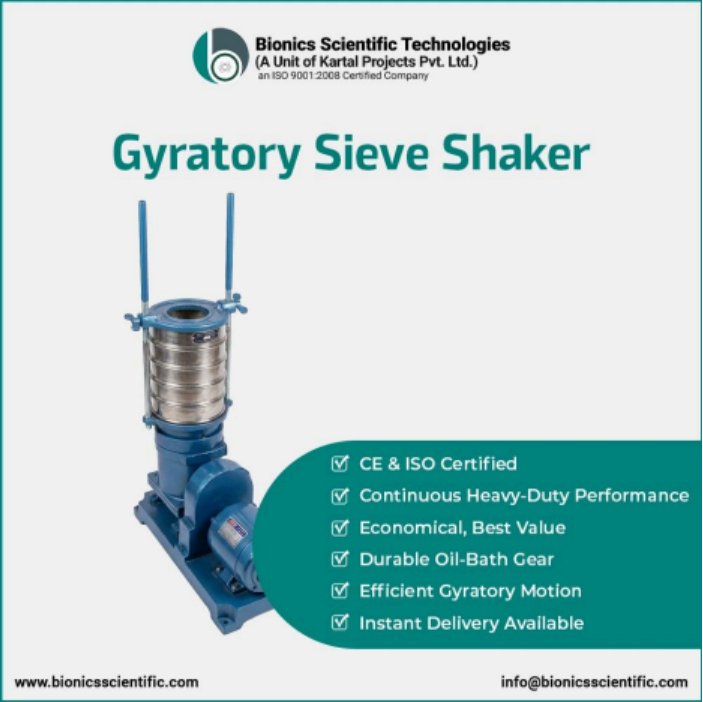
Particles size testing may seem a very simple process until one realizes how important motion of the particles is. For this reason, laboratory gyratory sieve shaker machine became so popular in all testing laboratories that need to get precise and repeatable results.
Difference Between Gyratory Movement and the Ordinary One
The ordinary way to shake the sieve includes movement of the sample up and down. With the use of the laboratory gyratory sieve shaker machine, particles will be subject to the combined horizontal circular motion and vertical tapping. Such kind of motion makes particles spread over the sieve surface, roll into the sieve openings and divide into groups by their sizes. It is a way to improve separation of fine powders, granules and particles with irregular shape.
The Significance of the Accuracy of the Results
Information about the distribution of the particles' sizes is an important factor to establish the quality of the product, its consistency and compliance with the regulations. A pharmaceutical company will face problems in providing the correct particle size of the powder that will dissolve at the right rate. A construction materials lab will make mistakes in defining the compliance with the ASTM or IS standards. In both cases, the equipment will play a vital role in providing accurate results.
The Features of the Laboratory Gyratory Sieve Shaker Machine
A well-designed laboratory gyratory sieve shaker machine is characterized by stack capacity for several sieve sizes, digital timer for test duration regulation, amplitude control to adjust to different sample density and locking mechanism for closing the stack of sieves during the test. Some models provide with tapping mechanism for freeing of the particles trapped in the sieve mesh.
Industries Using Such Equipments
Construction and civil engineering labs use sieve shakers for aggregate gradation test and proper mixture of concrete and asphalt mix design. Pharmaceuticals use such equipment for particle size test to check the consistency of their tablets and powders. Food processing and agricultural labs use sieve analysis to verify the consistency of grain, flour and powder according to the quality standards. Mining and mineral processing industries use gyratory sieve shakers for ore particle distribution test before making any decision.
Manual Sieving vs Mechanical Gyratory Sieving
Manual sieving can be used as a spot-check method, but it will add an additional degree of inconsistency, which will not be present when performing mechanical shaking. A gyratory sieve shaker guarantees that each test that is performed in laboratory conditions has same amount of time, same motion and same amplitude so that the result of Monday's sample can be compared with the result of the sample that was tested six months ago. In Bionics Scientific, this kind of
consistency is treated as one of the main goals of the machine – a gyratory sieve shaker that cannot provide same conditions repeatedly is pointless.
Choosing the Best Sieve Shaker Machine for You
Stack size of sieves, amplitude range, timer precision and conformity with testing standards should all be considered in relation with the material that is being tested since fine powder testing and coarse aggregate testing do not need same specifications of shaker.
Final Thoughts
Laboratory gyrtory sieve shakers do not just shake sieves stack, they create a motion pattern that will give consistent particle size results every time.
What's Your Reaction?