ABA vs Speech Therapy vs OT: Key Differences Explained
ABA vs speech therapy vs occupational therapy: learn what each does, who delivers it, how they differ, and how to choose the right support for your child.
ABA vs. Speech Therapy vs. Occupational Therapy: Understanding the Differences
By the AutismCue Editorial Team
When a child is diagnosed with autism or shows developmental delays, families often hear three terms right away: ABA, speech therapy, and occupational therapy. They sound similar, they are often recommended together, and parents are usually left wondering which one their child actually needs. If you are comparing ABA vs speech therapy, this guide explains what each therapy does, who provides it, and how they differ in plain language.
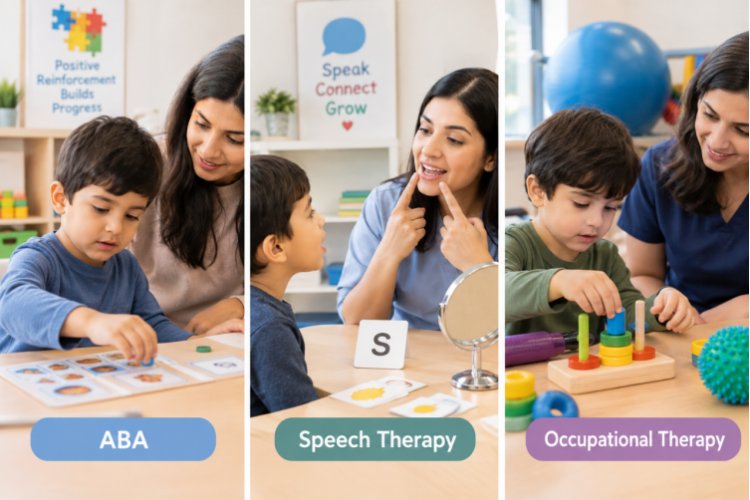
Quick Answer: What Is the Difference?
● ABA (Applied Behaviour Analysis) studies how behaviour works and uses structured teaching and reinforcement to build skills and reduce behaviours that get in the way of daily life.
● Speech therapy helps a child understand language, express themselves, and communicate with others, whether through words, gestures, pictures, or devices.
● Occupational therapy (OT) helps a child manage everyday activities such as dressing, eating, writing, playing, and coping with sensory input.
In short: ABA focuses on behaviour and learning, speech therapy focuses on communication, and OT focuses on daily living and sensory and motor skills.
What Is ABA Therapy?
Applied behaviour analysis is an approach based on the science of learning. It looks at what happens before a behaviour (the trigger), the behaviour itself, and what happens after (the result). By understanding that pattern, a therapist can teach new skills and make helpful behaviours more likely.
Who provides ABA?
A Board Certified Behaviour Analyst (BCBA) usually designs the plan and supervises the work. Registered Behaviour Technicians (RBTs) or similar trained staff often deliver sessions directly with the child.
What does ABA work on?
● Communication and requesting
● Following instructions and routines
● Play and social skills
● Self-care, such as toileting and brushing teeth
● Reducing behaviours that cause harm or limit participation, such as aggression or running away
How do sessions look?
Modern ABA can happen at a table, but it is also commonly built into play and everyday routines, which is often called naturalistic teaching. Progress is tracked with data, and goals are reviewed regularly. Hours vary a lot. Some children receive a few hours a week, while others receive many more, depending on their needs and the recommendation of their team.
Something parents should know
ABA is the most widely studied behavioural approach for autism, and major health organisations recognise it. At the same time, some autistic adults and advocates have raised concerns about older, rigid forms of ABA that focused on compliance. Many providers now emphasise a child's comfort, consent, and strengths. It is reasonable to ask any provider how they approach these issues.
What Is Speech Therapy?
Speech therapy, also called speech-language therapy, is provided by a speech-language pathologist (SLP). The name can be misleading. It is not only about pronouncing words. SLPs work on the whole picture of communication.
What does speech therapy work on?
● Speech sounds: saying words clearly
● Language: understanding what others say and using words and sentences
● Social communication (pragmatics): taking turns in conversation, reading body language, staying on topic
● Alternative communication (AAC): picture boards, apps, or speech-generating devices for children who do not use spoken words yet
● Feeding and swallowing: some SLPs also help children who struggle with chewing or swallowing
Who needs it?
A child may benefit if they are not talking as expected for their age, repeat phrases without using them to communicate, struggle to follow directions, or find conversations with other children difficult. Importantly, a child who does not speak can still communicate, and an SLP can help find the method that works.
What Is Occupational Therapy?
In childhood, "occupation" does not mean a job. It means the activities that fill a child's day: getting dressed, eating, playing, learning, and caring for themselves. An occupational therapist (OT) helps children take part in these activities as independently as possible.
What does OT work on?
● Fine motor skills: holding a pencil, using scissors, fastening buttons
● Gross motor and coordination: balance, posture, and body awareness
● Sensory processing: strong reactions to sounds, lights, clothing textures, or food textures, or seeking out intense movement and pressure
● Daily living skills: dressing, feeding, toileting, and hygiene
● Play and school readiness: attention, organisation, and classroom participation
Who needs it?
OT is often helpful for children who avoid certain clothing or foods, get overwhelmed in noisy places, have trouble with handwriting, or seem clumsy or uncoordinated. Sensory integration is a common OT approach, though research on its effectiveness is still developing, so it is worth discussing the goals and how progress will be measured.
ABA vs Speech Therapy vs OT: Side-by-Side Comparison
|
Feature |
ABA |
Speech Therapy |
Occupational Therapy |
|
Main focus |
Behaviour and skill learning |
Communication and language |
Daily living, motor, and sensory skills |
|
Led by |
BCBA |
Speech-language pathologist |
Occupational therapist |
|
Typical goals |
Routines, play, behaviour, self-care |
Speech, understanding, social communication, AAC |
Handwriting, dressing, feeding, sensory regulation |
|
Teaching style |
Reinforcement and structured or play-based teaching |
Language-rich play, modelling, and practice |
Hands-on activities and sensory-motor play |
|
Progress tracking |
Ongoing data on targeted skills |
Language and speech assessments, goal checks |
Functional and developmental assessments |
Where the Three Therapies Overlap
The lines between these therapies are not sharp, and that is why parents get confused. For example:
● A child learning to ask for a snack may be working on communication (speech therapy), behaviour and routines (ABA), and the fine motor skill of opening the container (OT).
● Mealtime problems can involve sensory sensitivity (OT), chewing and swallowing (speech therapy), and refusal behaviours (ABA).
The difference is mostly in the training and the lens each professional uses. An SLP asks, "How is this child communicating?" An OT asks, "What is making this activity hard for the body or senses?" A behaviour analyst asks, "What is this behaviour doing for the child, and what can we teach instead?"
Can a Child Have All Three?
Yes. Many autistic children receive a combination, and the therapies tend to support each other. A child who gains communication skills in speech therapy may need less behaviour support, and a child who feels calmer after sensory work in OT may be more ready to learn in other sessions.
The key is coordination. When providers share goals and use consistent strategies, the child gets clearer support. Parents can help by asking therapists to talk to each other and by sharing school and home observations.
How to Decide Where to Start
There is no universal order, and no single therapy is right for every child. These points can help guide the conversation with your child's doctor or team:
1. Start with an evaluation. A developmental paediatrician or a multidisciplinary team can identify strengths and needs.
2. Look at the biggest daily challenge. Limited speech, sensory distress, and safety-related behaviours may each point to a different first step.
3. Ask about goals. Good goals are specific, measurable, and meaningful to your family, such as "asks for help using a picture card" rather than "improves communication".
4. Check credentials. Look for a BCBA for ABA, a licensed or certified SLP for speech therapy, and a licensed OT for occupational therapy. Credential names differ from country to country, so confirm what applies where you live.
5. Watch your child's response. Therapy should be respectful, and your child should generally seem safe and engaged. You are allowed to ask questions or change providers.
6. Review progress. Goals should be updated regularly, and therapies that are not helping should be adjusted.
Frequently Asked Questions
What is the main difference between ABA and speech therapy?
ABA focuses on understanding and changing behaviour by teaching skills with reinforcement. Speech therapy focuses on communication, including speech sounds, language, social communication, and sometimes feeding. ABA looks at behaviour across many areas, while speech therapy targets how a child understands and uses language.
Can a child receive ABA, speech therapy, and OT together?
Yes. Many autistic children receive more than one therapy at the same time. Each one targets different needs, so they often complement each other. Good results depend on the providers sharing goals and updates, so everyone uses consistent strategies at home, at school, and in sessions.
Which therapy should start first?
There is no single correct order. The best starting point depends on the child's biggest challenges. Limited speech may point to speech therapy or sensory or motor difficulties occupational therapy, and challenging behaviour to ABA. A developmental evaluation helps professionals recommend priorities for your child.
Is ABA the same as speech therapy for non-speaking children?
No. ABA may teach requesting and other communication skills, but speech-language pathologists are trained specifically in language development and communication disorders. For non-speaking children, an SLP can assess and introduce augmentative and alternative communication (AAC), such as picture systems or speech-generating devices.
What does occupational therapy do for autistic children?
Occupational therapy helps children take part in everyday activities. Therapists work on fine motor skills, handwriting, dressing, feeding, play, and sensory processing, such as sensitivity to sounds or textures. The goal is greater independence at home, school, and in the community.
How do I know if a therapist is qualified?
Check credentials. ABA is usually led by a Board Certified Behaviour Analyst (BCBA), speech therapy by a licensed speech-language pathologist (CCC-SLP), and occupational therapy by a licensed occupational therapist (OTR/L). Ask about experience with autism, how progress is measured, and how families are involved.
What's Your Reaction?