The Shift from Ready-Made Apps to Purpose-Built Digital Ecosystems
Discover why businesses are moving beyond ready-made apps toward purpose-built digital ecosystems that improve scalability, integration, efficiency, and long-term growth.
For more than a decade, the dominant paradigm in software has been the “ready-made app.” Whether it’s a project management tool, a CRM, a messaging platform, or a finance dashboard, organizations have largely operated by selecting pre-built applications and stitching them together. This approach worked well when business needs were relatively stable and workflows were simple enough to be adapted to standardized tools.
But that era is steadily fading.
We are now entering a phase where digital transformation is no longer about adopting isolated apps—it’s about building interconnected, purpose-built digital ecosystems designed around how a specific organization actually works. Rather than relying solely on off-the-shelf solutions, many businesses are turning to custom app development services to create software that aligns with their unique operational requirements.
Instead of forcing business processes into generic software, companies are increasingly shaping software around their processes, data flows, and strategic goals, enabling greater flexibility, scalability, and long-term value.
This shift is not cosmetic. It is structural. And it is reshaping how software is built, purchased, integrated, and evolved.
The Era of Ready-Made Apps: Standardization at Scale
Ready-made applications rose to dominance for a simple reason: efficiency through standardization.
In the early cloud software era, businesses needed quick solutions. Instead of building software from scratch, they could subscribe to tools like CRM platforms, communication suites, or analytics dashboards. These tools came with predefined workflows, standardized data models, and predictable user experiences.
The benefits were obvious:
● Fast deployment without engineering effort
● Lower upfront cost compared to custom development
● Reliable updates and vendor support
● Established best practices embedded in workflows
This model worked especially well for small and mid-sized businesses that lacked large engineering teams. Even enterprises embraced it because it reduced complexity and accelerated digital adoption.
However, this convenience came with a trade-off: rigidity.
Over time, organizations discovered that their unique workflows often did not fit neatly into standardized software. Instead of software adapting to the business, businesses began adapting to software. Teams restructured processes, created manual workarounds, or relied heavily on spreadsheets and integrations to fill the gaps.
The cracks in the model started to show.
The Breaking Point: When Apps Become Silos
As companies adopted more and more SaaS tools, another problem emerged: fragmentation.
Each department began using its own specialized tools:
● Marketing used one platform for campaigns
● Sales used another CRM system
● Product teams tracked work in separate project tools
● Finance relied on entirely different systems
Each application solved a specific problem well—but they rarely spoke the same language.
This led to what many organizations quietly struggle with today: data silos.
Information became scattered across disconnected systems, making it difficult to gain a unified view of customers, operations, or performance. Even when integrations existed, they were often brittle, expensive, or limited in scope.
The consequences were significant:
● Inconsistent data across departments
● Delayed decision-making due to fragmented insights
● Duplicate work and manual reconciliation
● Difficulty scaling processes across teams
In essence, organizations gained many tools but lost coherence.
This fragmentation set the stage for a new idea: instead of adding more apps, what if companies built ecosystems?
The Rise of Purpose-Built Digital Ecosystems
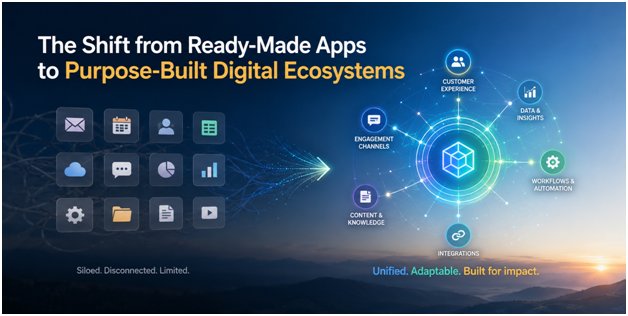
A purpose-built digital ecosystem is not just a collection of apps. It is a coordinated system of tools, data, workflows, and automation designed around a specific organization’s needs.
Whereas ready-made apps are designed for the average user, ecosystems are designed for a specific user environment.
At the core of this shift is a change in philosophy:
● From “What tool should we adopt?”
to
● “What system should we design?”
A digital ecosystem typically includes:
● Modular applications tailored to business functions
● Shared data infrastructure
● Integrated workflow automation
● API-first architecture for connectivity
● Custom user experiences layered on top of shared systems
Rather than living as isolated units, components of the ecosystem are deeply interconnected.
The result is not just better software—it is a more coherent operational structure.
Why This Shift Is Happening Now
Several technological and business trends are converging to accelerate this transition.
1. The maturity of APIs and integration layers
Modern software is increasingly built with APIs at its core. This makes it far easier to connect systems, exchange data in real time, and orchestrate workflows across multiple tools.
What used to require complex custom engineering can now be achieved through standardized integration layers.
2. The rise of low-code and no-code platforms
Low-code tools have empowered non-developers to build internal applications and workflows. This has shifted software creation from centralized IT departments to distributed teams.
As a result, companies can now assemble ecosystem-like structures without fully custom-building everything from scratch.
3. Explosion of data-driven decision-making
Organizations are no longer satisfied with static dashboards. They want real-time, unified, and actionable insights across all business functions.
This requires integrated systems rather than isolated apps.
4. Increasing complexity of business operations
Modern businesses operate in highly dynamic environments. Supply chains are global, customer journeys are multi-channel, and competition evolves rapidly.
Rigid tools struggle to keep up with this complexity. Ecosystems, however, are adaptable by design.
5. AI as a unifying layer
Artificial intelligence is increasingly acting as a connective tissue across systems. Instead of users navigating multiple apps, AI-driven interfaces can pull data and execute workflows across the ecosystem seamlessly.
This reinforces the need for interconnected systems rather than standalone tools.
Ready-Made Apps vs Digital Ecosystems: A Fundamental Shift
To understand the magnitude of this change, it helps to compare the two approaches conceptually.
Ready-Made Apps
● Designed for broad audiences
● Fixed workflows and features
● Limited customization
● Independent data systems
● Integration is secondary
Purpose-Built Ecosystems
● Designed for specific organizations or industries
● Flexible, modular workflows
● High degree of customization
● Shared data infrastructure
● Integration is foundational
The key difference lies in orientation.
Apps are product-centric. Ecosystems are system-centric.
The Organizational Impact: From Tool Users to System Designers
One of the most profound consequences of this shift is how it changes the role of organizations themselves.
In the ready-made app era, companies were primarily users of software. They selected tools, trained employees, and adapted processes around them.
In the ecosystem era, companies become designers of their own digital environments.
This requires a different mindset:
● Understanding internal workflows deeply
● Mapping data flows across departments
● Designing integration logic between systems
● Continuously evolving digital infrastructure
IT departments are no longer just support functions—they become architecture teams.
Similarly, business teams become co-creators of software systems rather than passive users.
The Role of Data: The Backbone of Ecosystems
If apps are buildings, ecosystems are cities—and data is the infrastructure that connects everything.
In a purpose-built ecosystem, data is:
● Centralized or federated in a unified architecture
● Continuously synchronized across tools
● Structured to support multiple use cases simultaneously
● Governed for consistency and security
This contrasts sharply with the app-centric model, where each tool maintains its own database and defines its own version of truth.
Without unified data, ecosystems collapse into loosely connected apps again.
With unified data, they become intelligent systems capable of automation, prediction, and optimization.
Challenges in Building Digital Ecosystems
While the ecosystem model is powerful, it is not without challenges.
1. Higher initial complexity
Designing an ecosystem requires careful planning. Unlike ready-made apps, there is no single vendor solution that “just works” out of the box.
2. Integration overhead
Even with modern APIs, integrating multiple systems requires ongoing maintenance and governance.
3. Skill requirements
Organizations need talent that understands systems thinking, data architecture, and workflow design—not just software usage.
4. Risk of over-customization
Without discipline, ecosystems can become overly complex, leading to technical debt and inefficiency.
5. Change management
Shifting from apps to ecosystems requires cultural transformation. Teams must adapt to new ways of working and thinking.
Despite these challenges, many organizations are finding that the long-term benefits outweigh the initial friction.
The Hybrid Future: Apps Inside Ecosystems
It is important to note that ready-made apps are not disappearing.
Instead, they are being absorbed into larger ecosystems.
Modern ecosystems often consist of:
● SaaS tools used as modular components
● Custom-built orchestration layers
● Unified data platforms
● Automation and AI-driven workflows
In this hybrid model, apps still exist—but they no longer operate in isolation. They become interchangeable parts of a larger system.
The real value is no longer in individual tools, but in how those tools interact.
What This Means for the Future of Software
The shift toward purpose-built digital ecosystems signals a broader evolution in software itself.
We are moving from:
● Static tools → dynamic systems
● Isolated applications → interconnected architectures
● User-driven interfaces → intelligent orchestration
● Manual workflows → automated ecosystems
In the long run, the distinction between “software” and “business operations” may blur entirely. Organizations will increasingly operate through living digital systems that continuously adapt, learn, and optimize.
Software will not just support business—it will become the structure of the business itsel
Conclusion: From Tools to Systems Thinking
The transition from ready-made apps to purpose-built digital ecosystems is not just a technological shift. It is a shift in mindset.
It reflects a growing realization that modern organizations cannot be efficiently run through disconnected tools. Complexity demands coherence. Speed demands integration. Intelligence demands unified data and workflows.
Ready-made apps will continue to play a role, especially as building blocks. But the real competitive advantage will belong to organizations that move beyond tool adoption and embrace system design.
In the end, the question is no longer:
“What software should we use?”
It is:
“What system should we build to run our organization?”
What's Your Reaction?