Mainland Company Formation in Dubai 2026
Set up a mainland company formation in Dubai without a local sponsor. Learn the 2026 steps, costs, legal structure, and compliance rules in full.
How to Set Up a Mainland Company in Dubai Without a Local Sponsor in 2026
You might have heard that you need a local citizen to own 51% of your company to start a business in the UAE. That used to be true, but the rules have completely changed. You don't need to search for local support anymore.
Today, you can easily launch your dream business with complete control. The UAE's Commercial Companies Law allows 100% foreign ownership across 100 commercial and industrial activities for mainland company setup. Keep reading to know exactly how to navigate mainland company formation in Dubai without a local partner this year.
What is Mainland Company Formation in Dubai?
Let us clear up the basics first. What is mainland company formation in Dubai?In simple terms, a mainland company is an onshore business registered under the Dubai Department of Economy and Tourism (DET).
Unlike other setups, a mainland license gives you the freedom to trade directly in the local UAE market and pursue lucrative government contracts without geographic restrictions.
Historically, expats needed a local UAE national sponsor who held the majority of the shares.
However, the recent legal reforms have changed that rule, allowing the foreign investor to hold 100% of the shares.
You can now retain full ownership of your business across thousands of commercial and industrial activities with the help of business setup consultants in Dubai.
The Key Steps to Establish Your UAE Mainland Business Without a Sponsor
Getting your license is a structured process. You can get your business up and running in a matter of weeks if you follow these chronological steps.
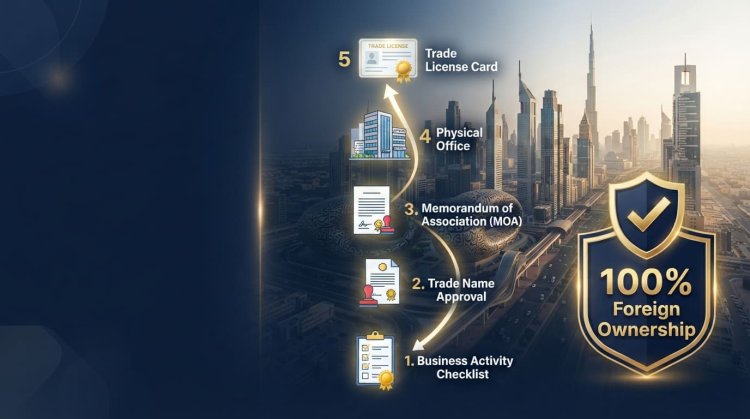
1) Step 1-Define Your Business Activity and Legal Structure
Your first move is to pick your specific business activities from the DET list. This choice dictates whether you need a commercial license (for trading) or a professional license (for consultancy and services).
You will also finalize your legal structure, such as a Limited Liability Company (LLC) or a Sole Establishment.
2) Step 2-Reserve Your Trade Name and Get Initial Approval
Next, you need to submit your proposed business name to the government. You will apply for an initial approval certificate once your name is approved.
This document is a simple confirmation that the UAE government has no objection to you starting your business.
3) Step 3-Draft the MOA or LSA Agreement
You will draft a Memorandum of Association (MOA) outlining your corporate structure for an LLC.
Since you do not need a local sponsor to own shares, you may only need a local service agent (LSA) to handle government paperwork if you are setting up a professional services civil company.This agent has zero equity and zero say in your business operations.
4) Step 4-Secure a Physical Office and Register Ejari
Every mainland company setup requires a physical address. You must rent an office space and get an Ejari (the official, registered tenancy contract from the Dubai Land Department).
The size of your office directly dictates how many employee visas you can apply for.
5) Step 5- Pay the Fees and Collect Your License
Finally, you will submit your signed MOA, Ejari, and passport copies to the DET.
Your commercial trade license will be issued once you clear the DED license fees 2026 invoice, which typically ranges from AED 10,000 to AED 25,000 for the core license component.
Mainland vs. Free Zone- A Quick Comparison Table
The mainland and free zone are the two most common setups in Dubai. Let's take a look at the quick differences for a better understanding of a Dubai mainland company and a Dubai Free Zone Company Registration.
|
Feature |
Dubai Mainland Company |
Dubai Free Zone Company |
|
Ownership |
100% Foreign Ownership |
100% Foreign Ownership |
|
Trade Location |
UAE and Internationally |
Free Zone and International |
|
Office Space |
Physical space mandatory |
Flexi-desk or virtual options allowed |
|
Visa Quotas |
Unlimited |
Limited |
2026 Key Rules Every Business Owner Must Know
Operating a mainland business setup in UAE means you fall under direct federal labor laws. You need to pay close attention to employee headcounts if youare planning to scale your team.
You must meet mandatory quotas for hiring UAE nationals if your mainland workforce grows to 20 or more employees in specific industries, or reaches 50 employees in general.
Failing to meet these targets results in steep monthly fines, so keep these Emiratization requirements UAE in mind as you map out your hiring pipeline.
How To Handle Your Post-Setup Requirements
Getting your license is a massive milestone. However, you are not fully ready to trade until you check a few more regulatory boxes.
· Visas and Corporate Banking
Once your license is active, you can apply for your establishment card to start sponsoring employee visas.
As a business owner, you may also qualify for a UAE Golden Visa business owner status, which gives you a 10-year residency without needing a local sponsor.
You can then open your corporate bank account with your legal docs in hand.
· Tax and Compliance
The UAE has modernized its business environment, which means keeping up with local tax rules is non-negotiable. You must ensure full FTA compliance UAE (Federal Tax Authority) rules by monitoring your local revenue thresholds.
If your taxable turnover goes over AED 375,000, you are legally required to sign up for value-added tax.
Make sure to secure a Professional VAT Registration in Dubai right after your setup to avoid heavy compliance penalties.
Partnering with experienced consultants can save you weeks of delays. They help with navigating:
· Government portals
· commercial leases
· Legal translations
Expert consultants handle everything from your mainland company setup Dubai paperwork to tax registration, letting you focus entirely on growing your brand.
Summary of Total Estimated Costs
Here is a breakdown of what to expect for a standard business setup in Dubai mainlandto help you budget accurately for your first year.
|
Expense Component |
Estimated Cost ( AED) |
|
Trade License Fee (DET) |
AED 10,000 - AED 25,000 |
|
Initial Approvals and Name |
AED 2,000 - AED 5,000 |
|
Office Rent and Ejari |
AED 15,000 - AED 40,000 |
|
Visa Processing (Per Person) |
AED 3,500 - AED 6,000 |
Always request a transparent cost breakdown from your setup partner to ensure government fees and service fees are listed separately.
FAQS
1) What happens if I choose a professional license instead of a commercial one?
A professional license is meant for service-oriented businesses, like consulting, IT services, or design. It allows you 100% sole ownership of your business. You do not need a local partner to own shares. But you will work with a local service agent who acts as a representative to speed up government registrations for a set annual fee.
2) Can I change my existing Free Zone company to a mainland business setup in UAE?
You cannot directly convert a free zone license into a mainland one because they are governed by completely different regulatory bodies. However, you can easily open a new mainland branch of your free zone company or start a fresh mainland company setupto expand your operations into the local market.
3) Is there a minimum capital requirement to set up a business in the Dubai mainland?
There is no mandatory minimum capital requirement specified by the DET to establish your UAE mainland business as a standard Limited Liability Company (LLC) on the mainland. You simply need to state your operational capital in your company's Articles of Association based on what your specific business needs to get off the ground.
Final Word
Starting a business on the Dubai mainland without a local sponsor has never been more straightforward. By understanding the step-by-step registration process, leasing the right office space, paying all the fees, and staying on top of your local tax compliance, you can build a highly successful, fully independent corporate presence in the heart of the UAE.
What's Your Reaction?