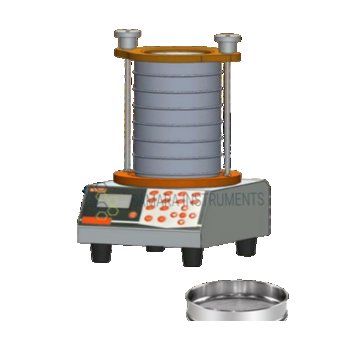
Laboratory Electromagnetic Sieve Shaker Machine
Electromagnetic Sieve Shaker for particle size analysis, with programmable amplitude, low noise operation, and dry/wet sieving options.
What Is a Laboratory Electromagnetic Sieve Shaker?
At its core, a Laboratory Electromagnetic Sieve Shaker is a device designed to separate particles based on size using a stack of sieves and controlled vibration.
But unlike traditional mechanical shakers, this machine uses electromagnetic energy to create highly controlled, consistent, and repeatable vibrations.
Think of it like this:
Instead of a rough, uneven shaking motion, the electromagnetic system produces smooth, precise pulses. These pulses allow particles to move efficiently through the sieves, ensuring accurate separation without damaging the material.
The result?
Cleaner data. Better analysis. More confidence in results.
Why Particle Size Matters More Than You Think
If you were to look at a pile of sand, you might think it’s uniform. But under a microscope, it’s a mix of particles—some fine, some coarse, each playing a role.
In American industries, particle size affects:
- Strength of construction materials
- Dissolution rate of pharmaceuticals
- Texture and quality of food products
- Efficiency of chemical reactions
- Performance of industrial powders
- Filtration and flow behavior
Even a slight variation in particle size can change how a product performs in the real world.
That’s why laboratories rely on sieve analysis—and why they demand accuracy.
How the Electromagnetic Sieve Shaker Works
Let’s walk through what happens inside the machine.
- Stacking the Sieves
A series of sieves with different mesh sizes are stacked one above the other, with the coarsest at the top and the finest at the bottom. - Adding the Sample
The material to be tested is placed on the top sieve. - Electromagnetic Vibration Begins
The machine generates controlled electromagnetic pulses that move the sieve stack vertically (and sometimes slightly horizontally). - Particle Separation
Smaller particles pass through finer meshes, while larger particles remain on top sieves. - Data Collection
After a set time, each sieve is weighed to determine how much material remains, giving a clear picture of particle distribution.
What makes this system special is the precision control over amplitude, frequency, and duration.
Why American Labs Prefer Electromagnetic Systems
In the United States, quality standards are high across industries. Laboratories are expected to deliver accurate, repeatable results.
Electromagnetic sieve shakers offer several advantages:
1. Consistency You Can Trust
Unlike mechanical systems, electromagnetic shakers produce uniform vibrations every time. This ensures consistent test results.
2. Reduced Noise and Maintenance
They operate quietly and have fewer moving parts, reducing wear and tear.
3. Precision Control
Operators can fine-tune vibration intensity for different materials.
4. Faster Testing
Efficient particle movement reduces test time without compromising accuracy.
5. Better for Delicate Materials
Fragile particles are less likely to break during testing.
Industries in the USA That Rely on This Machine
The reach of this machine is broader than most people expect.
Construction and Civil Engineering
In states like California, Texas, and Florida, construction materials must meet strict standards. Sieve shakers help analyze:
- Sand
- Cement
- Aggregates
- Asphalt mixtures
Pharmaceuticals
In the pharmaceutical industry, particle size affects how drugs dissolve and are absorbed in the body. Laboratories use sieve shakers to ensure:
- Uniform dosage
- Consistent quality
- Regulatory compliance
Food and Agriculture
From flour mills in the Midwest to food processing plants across the country, sieve shakers ensure:
- Consistent texture
- Proper grain grading
- Quality control
Mining and Minerals
Mining operations across the USA rely on particle analysis for:
- Ore processing
- Material classification
- Efficiency optimization
Chemicals and Powder Industries
Chemical manufacturers use sieve shakers to control:
- Reaction efficiency
- Product consistency
- Flow properties
The Human Side of the Machine
Behind every test is a person—an engineer, a lab technician, a quality manager.
For them, the sieve shaker is more than equipment. It’s a partner in decision-making.
It helps answer critical questions:
- Is this material safe to use?
- Will it perform as expected?
- Does it meet industry standards?
- Can we release this batch?
There’s a certain satisfaction in running a test and seeing clear, reliable results. It removes doubt. It builds confidence.
Key Features That Make a Difference
Modern electromagnetic sieve shakers come with features designed for efficiency and accuracy:
Digital Controls
Easy-to-use interfaces allow precise setting of time and vibration intensity.
Programmable Settings
Users can save test parameters for repeated use.
Timer Functions
Automatic operation ensures consistent testing cycles.
Compact Design
Fits easily into laboratory spaces.
Robust Construction
Built to handle continuous use in demanding environments.
Choosing the Right Machine in the USA
Selecting the right sieve shaker depends on several factors:
Type of Material
Different materials require different vibration intensities.
Sample Volume
Larger samples may need more powerful systems.
Industry Requirements
Some industries have strict testing standards.
Frequency of Use
High-volume labs need durable, heavy-duty machines.
Budget Considerations
Balancing cost with long-term value is key.
For American businesses, the decision often comes down to reliability and compliance.
Common Challenges and How This Machine Solves Them
Problem: Inconsistent Results
Solution: Electromagnetic control ensures repeatability.
Problem: Particle Breakage
Solution: Gentle vibration protects delicate materials.
Problem: Long Testing Times
Solution: Efficient separation speeds up analysis.
Problem: Equipment Wear
Solution: Fewer moving parts reduce maintenance needs.
The Role of Standards and Quality Control
In the USA, industries operate under strict quality standards. Sieve analysis is often part of these requirements.
Electromagnetic sieve shakers help laboratories:
- Meet compliance requirements
- Maintain product consistency
- Pass audits and inspections
- Build customer trust
The Future of Sieve Shaking Technology
Technology is evolving, and so are these machines.
We are seeing:
- Integration with software for data analysis
- Automated reporting systems
- Enhanced energy efficiency
- Improved ergonomics
- Smart diagnostics for maintenance
The goal is simple: make testing faster, smarter, and more reliable.
A Silent Contributor to Everyday Life
Most people in the United States will never see a sieve shaker. But they benefit from it every day.
It ensures:
- Stronger buildings
- Safer medicines
- Better food quality
- More reliable products
It works quietly in the background, turning raw materials into dependable results.
Frequently Asked Questions (FAQs)
Q1: What is the main purpose of a laboratory electromagnetic sieve shaker?
It is used to separate and analyze particles based on size, helping determine particle distribution in a sample.
Q2: How is it different from a mechanical sieve shaker?
Electromagnetic shakers use controlled vibrations, offering more precision, consistency, and less noise compared to mechanical systems.
Q3: Which industries use this machine the most in the USA?
Construction, pharmaceuticals, food processing, mining, and chemical industries are the primary users.
Q4: Can it handle all types of materials?
Yes, but settings may need adjustment depending on whether the material is fine, coarse, fragile, or dense.
Q5: How long does a typical test take?
Most tests range from 5 to 30 minutes, depending on the material and required accuracy.
Q6: Is it easy to operate?
Yes, modern machines come with user-friendly digital controls and programmable settings.
Q7: Does it require frequent maintenance?
Not much. With fewer moving parts, electromagnetic systems generally require less maintenance than mechanical ones.
Q8: Can it be used for wet sieving?
Some models support wet sieving, but this depends on the machine design.
Q9: Why is particle size analysis important?
It affects product quality, performance, safety, and compliance across various industries.
Q10: What should I consider before buying one?
Consider material type, sample size, testing frequency, industry standards, and budget.
What's Your Reaction?