How Long Does Beard Transplant Recovery Take?
If you're considering a beard transplant in Gurgaon, or you've just had one done, here's what the recovery actually looks like — stage by stage, without the vague "results vary" hand-waving.
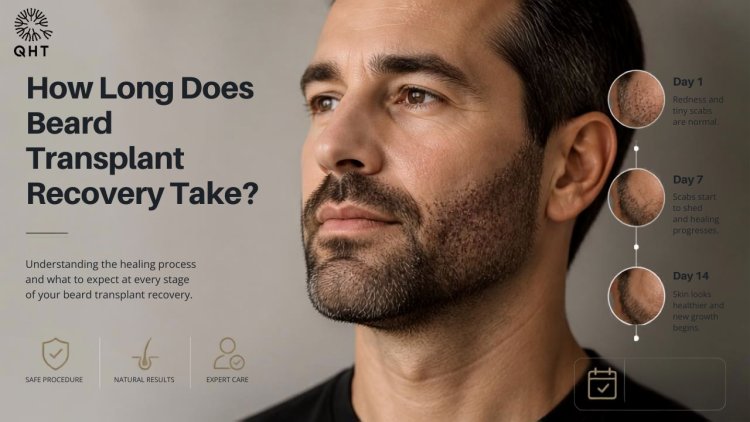
Most people asking about beard transplant recovery aren't really asking about downtime. They're asking a more specific question: when does this actually start looking like a beard?
Fair question. And the honest answer isn't a single number — it's a process that unfolds in stages, some of which look worse before they look better.
If you're considering a beard transplant in Gurgaon, or you've just had one done, here's what the recovery actually looks like — stage by stage, without the vague "results vary" hand-waving.
Why Beard Transplant Healing Isn't a Straight Line
A beard transplant works the same way a scalp FUE transplant does. Individual follicles get extracted from the donor area — usually the back of the scalp — and implanted one by one into the jaw, cheeks, and chin.
What throws people off is the shedding phase that follows. Transplanted hairs typically fall out within the first few weeks. That's normal. It's not the graft failing — it's the follicle resetting itself before it starts producing hair on its own growth cycle. Most patients don't expect this part, which is exactly why it causes so much unnecessary panic.
Recovery Timeline: Day by Day, Week by Week
Days 1–3: Redness and swelling. Both the donor area and the newly implanted zone will look red, a bit swollen, and tender. Tiny scabs start forming around each graft. This is the most fragile stage — the grafts haven't anchored yet.
Days 4–7: Scabbing peaks, then starts fading. Scabs are at their most visible around day 4 or 5, then begin flaking off naturally by day 7. Don't pick at them — that's one of the fastest ways to dislodge a graft that hasn't settled in yet.
Week 2: The face starts looking more normal. Most of the redness has calmed down. This is also around when the shedding phase can begin — implanted hairs start falling out, which can feel discouraging if you don't know it's coming.
Week 3–4: The "nothing's happening" phase. This stretch is the hardest part for most patients, purely psychologically. The transplanted hairs have shed, and new growth hasn't started yet. The skin looks mostly healed, but the beard itself looks patchy or bare. Nothing is wrong — the follicles are simply resetting.
Month 2–3: First real signs of growth. Fine, thin hairs start appearing in the transplanted areas. Growth is uneven at this stage — some patches fill in faster than others — which is normal and not a sign of graft failure.
Month 4–6: Visible density builds up. Hair thickens and coarsens, and the beard starts taking real shape. By month 6, most patients have a good sense of how the final result will look, even if it's not fully mature yet.
Month 8–12: Final results settle in. This is when the beard reaches its full thickness and texture. Some patients see continued refinement up to the 12-month mark, since facial hair follicles can take longer to fully mature than scalp hair.
The Part Most Guides Skip: Why Month 3 Causes the Most Anxiety
Almost every recovery guide walks through the timeline in a straight line, but doesn't explain why month 2–3 is where most patients start second-guessing the whole procedure.
Here's what's actually happening: the shedding phase has finished, but new growth hasn't caught up yet. Visually, this is often the least impressive point in the entire recovery — patchier than day 1, less full than month 6. Patients who don't know this is a normal, temporary dip sometimes assume the transplant didn't work, when in reality the follicles are just mid-cycle.
Knowing this in advance changes how people experience recovery. It's the difference between panicking at week 10 and simply waiting it out.
What Affects How Fast (and How Well) You Heal
Recovery speed isn't identical for everyone. A few factors shift the timeline:
● Graft count — a higher number of grafts generally means a longer visible healing phase
● Skin type — oilier or more sensitive skin can take slightly longer to fully settle
● Aftercare discipline — sun exposure, sweat, and touching the area too early all slow things down
● Donor area health — how well the donor zone (usually the scalp) heals affects overall comfort during recovery, even though it's a separate healing site
● Individual hair growth cycle — facial hair grows in cycles that vary person to person, which is why some patients see visible thickness by month 4 and others closer to month 6
A Few Things That Genuinely Speed Up Recovery
● Avoid direct sun exposure on the treated area for at least the first few weeks
● Don't shave the transplanted area until your surgeon confirms it's safe — usually after the first month
● Keep the area clean but avoid scrubbing or picking at scabs
● Stay off intense exercise for the first week or two, since sweat and friction can disturb healing grafts
● Follow the specific washing schedule given by your clinic rather than a generic online routine
Why Recovery Speed Also Comes Down to the Procedure Itself
How smoothly this timeline plays out isn't purely about aftercare. Graft placement angle, extraction precision, and how densely grafts are packed during the transplant all affect how quickly the area heals and how natural the final growth pattern looks.
At QHT Clinic, beard transplants are performed with attention to natural hair direction and density mapping specific to facial hair growth patterns — which is a different skill set from scalp transplants, since facial hair grows at sharper angles and in a less uniform pattern. That precision at the time of surgery is often what separates a beard that grows in looking natural from one that looks visibly "placed."
What's Your Reaction?