How Specialized AI Agents Can Work Together to Solve Complex Problems
Multi-agent AI systems consist of multiple specialized agents that collaborate to achieve a shared objective. Their effectiveness depends on how they communicate, exchange information, and manage task dependencies.
A business decision rarely depends on just one piece of information. A product team may need customer feedback, sales data, technical reports, and budget estimates before deciding what to develop next. Collecting and analysing all this information can take considerable time, especially when it comes from different platforms.
A single AI assistant can help with individual tasks, but managing several connected responsibilities may require a more coordinated approach. This is where specialized AI agents can make a difference.
Understanding Collaborative AI Architectures
Instead of asking one AI agent to manage every activity, businesses can divide complex work into smaller responsibilities. Each agent receives a specific role, relevant information, and access to the tools required for its tasks.
For example, a product development team could use different agents for:
● Market research: Collecting information about customer needs and industry trends.
● Feedback analysis: Organising customer comments and identifying recurring issues.
● Technical evaluation: Reviewing requirements and potential limitations.
● Project planning: Combining findings into a structured development proposal.
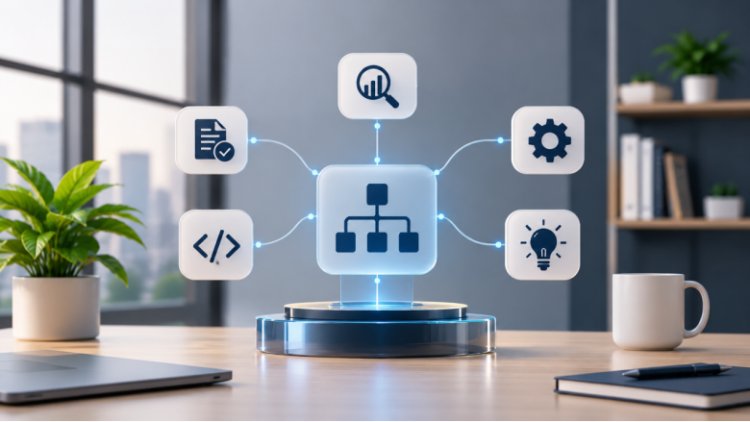
A coordinating component can collect these outputs, identify missing information, and prepare a consolidated recommendation for the product team.
How Multi-Agent AI Systems Coordinate Their Work
Multi-agent AI systems consist of multiple specialized agents that collaborate to achieve a shared objective. Their effectiveness depends on how they communicate, exchange information, and manage task dependencies.
There are several ways to organise their interactions.
Sequential coordination: One agent completes its task before passing the result to another. This works well when later activities depend on earlier findings.
Parallel execution: Multiple agents work on independent tasks simultaneously. For example, market research and technical analysis can happen at the same time.
Centralised orchestration: A coordinating agent assigns tasks, tracks progress, and combines the results.
Agent handoffs: One agent transfers control to another when a task requires a different capability or area of knowledge.
The right approach depends on the business objective, task dependencies, and required level of autonomy.
Where Can Businesses Apply This Architecture?
Multi-agent applications can support several business functions beyond basic customer interactions.
Financial analysis: Separate agents can organise financial documents, compare transaction records, and prepare summaries for human review.
Software development: Coding agents can assist with requirement analysis, code generation, testing, and documentation under developer supervision.
Marketing operations: Different agents can analyse audience behaviour, review campaign performance, and prepare content recommendations.
Healthcare administration: Agents can support document organisation, appointment coordination, and information retrieval while leaving clinical decisions to qualified professionals.
Education: Agents can help organise learning materials, assess administrative requests, and provide students with relevant course information.
These applications work best when responsibilities are clearly separated and the final output can be checked against reliable information.
What Does It Take to Build a Reliable System?
Building a collaborative AI architecture requires more than connecting several language models. Developers must decide how agents communicate, share context, access tools, and handle errors.
Important technical elements include:
● Large language models (LLMs): Provide language understanding and reasoning capabilities.
● Agent frameworks: Support agent creation, tool usage, and task execution.
● Orchestration: Manages delegation, communication, and workflow progression.
● RAG and vector databases: Help agents retrieve relevant information from business knowledge sources.
● API integrations: Connect agents with existing applications and databases.
● Monitoring and evaluation: Help measure individual agent performance and overall task completion.
Security is equally important. Each agent should have limited permissions, and sensitive actions should require appropriate validation or human approval.
When Should Businesses Consider Agentic AI Development Services?
Not every business problem requires multiple agents. A simple task may be handled more efficiently by traditional automation or a single AI agent.
However, when an application involves different areas of expertise, multiple data sources, and several connected decisions, a specialised architecture may be worth exploring.
This is where agentic ai development services can help businesses identify suitable use cases, design agent workflows, integrate existing applications, and establish testing and monitoring processes.
A practical implementation should begin with one clearly defined business challenge. Developers can establish a working baseline, introduce specialised agents where they provide measurable value, and gradually expand the system after testing its reliability.
Conclusion
Collaborative AI architectures offer a structured way to distribute complex work among specialized agents. Their real value comes from effective coordination, not simply increasing the number of AI components.
With suitable orchestration, secure integrations, and human oversight, businesses can build systems that manage complicated tasks more efficiently. The best starting point is always a real operational challenge where collaboration between specialized agents can make a measurable difference.
What's Your Reaction?