Vedanta Tuticorin Shutdown: A Big Loss for India
The Vedanta Tuticorin shutdown had huge implications which were beyond industrial loss. India, which was once a copper exporter, became increasingly dependent on imports after the plant’s closure.
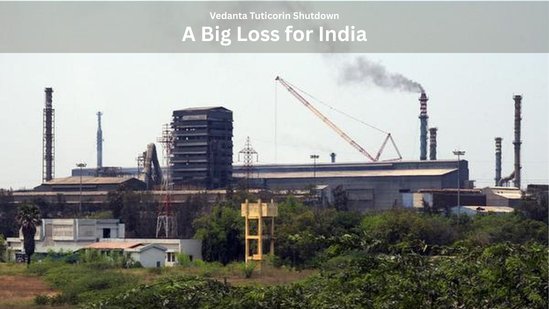
The closure of the Tuticorin Sterlite Copper in Tuticorin (Thoothukudi) in 2018 was not just the closure of a manufacturing unit; rather, it became a defining moment for India’s industrial ecosystem and for Vedanta as a company operating at the intersection of growth, regulation, and responsibility. Though such discussion has centred around numbers and timelines, the real story lies in the broader implications of the shutdown. Vedanta’s Sterlite copper plant closure affected not only the company’s operations, but it also meant job loss for the locals.
When an Industry Stands Still
For decades, the Vedanta Tuticorin plant was meeting the domestic copper demand. Also, beyond direct employment, the plant supported hundreds of small businesses, transport networks, maintenance contractors, and service providers. Vedanta Thoothukudi plant was much more than infrastructure; it was livelihood security for thousands of families.
But the closure of the plant impacted the state in many ways. The skilled workers faced uncertainty, growing businesses lost steady demand, and a well-established industrial ecosystem was suddenly disrupted. The closure highlighted a reality, which we often overlook, and this is – factory closures don’t occur in isolation; rather, they affect the entire communities.
Vedanta Urges for a Green Sterlite Copper Plant
Rather than being defined by the closure, Vedanta used the experience as a moment of strategic recalibration. The company has recently approached the Madras High Court seeking approval for a green copper manufacturing plant. The move reflects the company’s emphasis on sustainable industrial development and responsible resource management.
As per the petition filed by the company, it seeks a direction from the court to ask the state government to look into the matter, which is in accordance with the law. Further, Vedanta has requested to establish an expert committee consisting of representatives to streamline the restart process.
This proposed project reflects a transition in Vedanta’s operating philosophy—one that focuses on modern, environmentally conscious technologies that align with evolving regulatory expectations and global sustainability benchmarks.
Financial Impact Without Corporate Collapse
From a business point of view, the shutdown brought a huge operational gap for Vedanta’s copper segment. Today, when the global copper demand is increasing manifold- driven by electric vehicles, renewable energy, and infrastructure expansion, the lack of domestic production has altered the company’s revenue mix.
However, this disruption did not translate into financial instability. Vedanta’s diversified portfolio across zinc, aluminium, oil & gas, and iron ore provided resilience. Instead of weakening the company, the Tuticorin shutdown exposed the importance of diversification and risk distribution—an insight that many large industrial groups now prioritise.
Another huge impact of the Sterlite copper plant closure was felt by the locals. The workers who were trained over the years in specialised roles and were earning a decent amount suddenly found themselves navigating an uncertain job market. Contractual employees and small vendors faced even greater vulnerability.
A Shift in India’s Copper Story
The Vedanta Tuticorin shutdown had huge implications which were beyond industrial loss. India, which was once a copper exporter, became increasingly dependent on imports after the plant’s closure. This shift affected multiple sectors, including power, electronics, construction, and automotive manufacturing.
The increased dependence on imports not only increased the costs but also exposed Indian industries to global price volatility. In many ways, the closure highlighted how industrial operations directly influence national self-reliance and how it impacted the country’s manufacturing and infrastructure ambitions.
Regulation, Responsibility, and Due Process
At the heart of the Tuticorin issue was a complex balance between environmental concerns and industrial continuity. The prolonged legal proceedings that followed highlight the challenges of managing large-scale industrial regulation in a democratic framework.
For Vedanta, the process underscored the significance of regulatory engagement, transparency, and compliance as non-negotiable aspects of long-term operations. While for the policymakers, it highlighted the need for clear, consistent, and timely regulatory processes that protect public interest while ensuring investor confidence.
Conclusion
The closure of the Tuticorin copper plant was undeniably disruptive, but it also served as a powerful learning curve. For Vedanta, it highlights dedication, diversification, and responsible leadership, while for India, it highlights the importance of domestic manufacturing and balanced regulation.
Also, the recent application submission by Vedanta to the Madras High Court is a strategic move to start green copper manufacturing. Indeed, Vedanta is responsibly growing while shaping responsible industrial development in India.
What's Your Reaction?