Rain Test Chambers Manufacturer
Rain Test Chamber is generally used to conduct whole body testing of assembled vehicles under different rain test procedures.
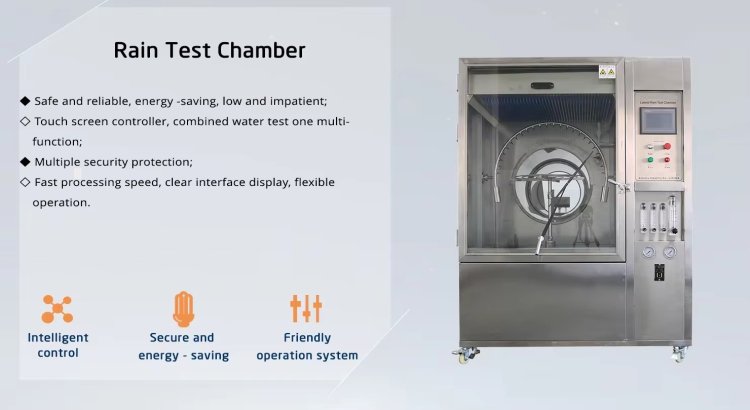
What Is a Rain Test Chamber, Really?
A Rain Test Chamber is a controlled environment machine designed to simulate different types of rainfall and water exposure on products.
But calling it “just a testing machine” is like calling a flight simulator “just a video game.”
A good rain test chamber can:
-
Recreate light rain, heavy rain, and extreme downpours
-
Simulate wind-driven rain from different directions
-
Control water pressure, flow rate, temperature, and angle
-
Run tests for minutes, hours, or even days
-
Repeat the same storm again and again with scientific precision
Inside this chamber, products face the worst weather of their lifetime—before they ever reach a customer.
Why Rain Testing Matters So Much in the USA
American customers are demanding. And rightly so.
If you buy:
-
A car
-
An outdoor security camera
-
A telecom cabinet
-
A streetlight
-
A solar inverter
-
A military-grade enclosure
-
A smartphone
-
A traffic signal controller
You expect it to work in rain, during storms, and after storms.
In the USA, lawsuits, recalls, and brand damage can cost millions. A single water-ingress failure can:
-
Shut down infrastructure
-
Cause safety hazards
-
Trigger massive warranty claims
-
Destroy a brand’s reputation overnight
Rain test chambers don’t just test products.
They protect companies from embarrassment, financial loss, and lost trust.
A Short Story from the Automotive World
In Michigan, a Tier-1 automotive supplier once struggled with a strange problem. A particular sensor module would occasionally fail after a few months of use. Not always. Not everywhere. Only in some regions.
After weeks of investigation, they realized the failures were concentrated in states with heavy seasonal rain.
The product passed basic water tests. But it failed in real life.
They invested in an advanced rain test chamber and started simulating wind-driven rain at highway speeds. Within days, the problem showed itself. Water was being forced into a tiny gap that normal tests never revealed.
A design change fixed it.
That rain chamber probably saved them millions of dollars in recalls.
What Gets Tested in Rain Chambers?
In the United States, rain test chambers are used across industries:
1. Automotive & EV Industry
-
Headlamps and tail lamps
-
Sensors and cameras
-
Battery enclosures
-
Connectors and wiring harnesses
-
Roof systems and door seals
2. Electronics & Consumer Devices
-
Outdoor cameras
-
Smart doorbells
-
Mobile phones
-
Laptops and rugged tablets
-
Outdoor speakers
3. Infrastructure & Utilities
-
Streetlight enclosures
-
Traffic signal cabinets
-
Telecom outdoor racks
-
Power distribution boxes
4. Aerospace & Defense
-
Avionics enclosures
-
Radar systems
-
Military communication equipment
-
Navigation systems
5. Construction & Building Products
-
Windows and facades
-
Roofing components
-
Outdoor HVAC units
-
Solar panels and inverters
If it lives outside—or might get wet—it belongs in a rain test chamber.
The Psychology of a Good Manufacturer
Great manufacturers don’t ask:
“Will this probably survive rain?”
They ask:
“How badly can we abuse this with water before it fails?”
Rain testing is not about being optimistic.
It’s about being brutally honest.
It’s about finding problems in the lab instead of in the field.
Inside a Modern Rain Test Chamber
A high-quality rain test chamber made for the US market is a serious piece of engineering.
It typically includes:
-
Stainless steel or corrosion-resistant structure
-
Multiple spray nozzles placed strategically
-
Adjustable water pressure and flow control
-
Rotating turntables for uniform exposure
-
Programmable control systems
-
Water filtration and recycling systems
-
Large viewing windows and internal lighting
-
Data logging and test reporting features
Some chambers are small enough for a smartphone. Others are big enough to park an SUV inside.
Different Types of Rain Tests
Not all rain is the same. And not all tests are the same.
1. Drip Test
Simulates water dripping vertically. Good for:
-
Ceiling-mounted devices
-
Lighting fixtures
-
Simple enclosure checks
2. Spray Test
Water sprayed at angles with controlled pressure. Good for:
-
Enclosures
-
Automotive components
-
Outdoor electronics
3. Driving Rain Test
Simulates rain combined with wind pressure. Good for:
-
Vehicles
-
Facades
-
Windows and doors
-
Outdoor cabinets
4. Heavy Rain / Storm Simulation
High flow rates, high pressure, long durations. Good for:
-
Extreme weather products
-
Military and aerospace equipment
-
Critical infrastructure
The Rise of Custom-Built Chambers in the USA
American manufacturers are unique. They often build unique products.
That’s why off-the-shelf chambers are not always enough.
Today, many US-based rain test chamber manufacturers focus on:
-
Custom sizes
-
Custom spray layouts
-
Special test cycles
-
Integration with temperature, dust, or humidity testing
-
Automation and Industry 4.0 compatibility
Some chambers are designed specifically for:
-
EV battery packs
-
Large trucks and buses
-
Solar panel arrays
-
Entire outdoor cabinets or shelters
What Makes a Great Rain Test Chamber Manufacturer?
In the USA, a good manufacturer is not just a machine seller. They are a testing partner.
They usually offer:
-
Deep understanding of real-world applications
-
Strong design and engineering capability
-
Customization instead of one-size-fits-all
-
Reliable after-sales support
-
Training and test method guidance
-
Long-term spare parts and service availability
A rain test chamber is not a cheap purchase. It’s a long-term investment in product quality.
The Business Case: Why It Pays for Itself
Let’s talk money.
A single product recall in the US can cost:
-
Millions in logistics
-
Millions in repairs or replacements
-
Millions in legal and compliance costs
-
And something priceless: brand trust
A rain test chamber:
-
Finds design flaws early
-
Reduces warranty claims
-
Improves customer satisfaction
-
Speeds up product development
-
Strengthens certification confidence
In many cases, it pays for itself by preventing just one major failure.
How Rain Testing Changes Company Culture
Something interesting happens when a company installs serious test equipment.
Engineers start designing differently.
They:
-
Think more about sealing
-
Think more about drainage paths
-
Think more about material aging
-
Think more about real-world abuse
The product becomes better not because of marketing—but because of evidence.
A Day in a US Test Lab
Imagine walking into a modern test lab in California or Texas.
On one side:
-
A large rain chamber is running a 6-hour driving rain test on an EV charging station.
On the other:
-
A smaller chamber is testing a new outdoor camera under intermittent spray.
Engineers are watching through the windows.
Data is being logged.
A few drops appear where they shouldn’t.
That’s not bad news.
That’s valuable news.
Choosing the Right Rain Test Chamber
When US companies look for a rain test chamber, they usually consider:
-
Size of products
-
Type of tests needed
-
Level of automation
-
Future expansion
-
Energy and water efficiency
-
Service and support availability
-
Compliance with internal and customer requirements
A good manufacturer helps ask the right questions before selling the machine.
The Future of Rain Testing in America
As products become:
-
More connected
-
More electric
-
More outdoor-dependent
Rain testing becomes even more critical.
Think about:
-
EV charging infrastructure
-
Smart cities
-
Outdoor IoT networks
-
Renewable energy systems
-
Autonomous vehicles
All of them live outside.
All of them must survive storms.
Rain test chambers are no longer “optional lab equipment.”
They are strategic infrastructure.
The Quiet Hero Behind Reliable Products
Most customers will never see a rain test chamber.
They will never know:
-
How many storms their product survived in a lab
-
How many design flaws were fixed before shipping
-
How many failures were prevented
They will only know one thing:
“It works. Even in bad weather.”
And that’s the point.
Final Thoughts: Turning Rain into Confidence
Rain is unpredictable.
But product performance shouldn’t be.
In the USA, where quality expectations are high and competition is fierce, rain test chambers give manufacturers something priceless:
Confidence.
Confidence that when the storm comes, their product will still stand.
Frequently Asked Questions (FAQs)
1. What is the main purpose of a rain test chamber?
The main purpose is to verify that a product can withstand water exposure, rain, and storm-like conditions without failing or allowing water ingress.
2. Which industries in the USA use rain test chambers the most?
Automotive, electronics, EV, aerospace, defense, infrastructure, construction, and renewable energy industries are among the biggest users.
3. Can rain test chambers be customized?
Yes. Many US manufacturers offer fully customized chambers based on product size, test requirements, and available space.
4. Are rain test chambers only for final products?
No. They are also used during R&D, prototyping, and design validation stages.
5. How long does a typical rain test take?
It can range from a few minutes to several hours or even days, depending on the test objective.
6. Do rain test chambers consume a lot of water?
Modern chambers often include water recycling and filtration systems to reduce water consumption.
7. Is rain testing only about water leakage?
No. It also helps evaluate corrosion risk, material degradation, seal performance, and long-term durability.
8. Can a rain test chamber simulate extreme storms?
Yes. Advanced chambers can simulate heavy rain, high-pressure spray, and wind-driven rain conditions.
9. Is investing in a rain test chamber worth it for a US manufacturer?
In most cases, yes. Preventing even one major field failure or recall can justify the investment.
10. How does rain testing improve product reputation?
It ensures consistent performance in real-world conditions, leading to fewer complaints, fewer failures, and higher customer trust.
What's Your Reaction?