Microprocessor Friability Test Apparatus
Microprocessor Friability Test Apparatus. Measures the tendency of a tablet to chip or breakdown to pieces when held under mechanical stresses.
When Tablets Are Tested for the Journey, Not Just the Shelf
In a pharmaceutical lab in the United States, a bottle of tablets sits quietly on a stainless-steel bench. They look solid. Smooth. Perfectly formed. But their real challenge has not yet begun.
Before these tablets ever reach a pharmacy in California, a hospital in Texas, or a medicine cabinet in New York, they must survive a long journey. Manufacturing lines. Packaging machines. Transportation trucks. Warehouses. Daily handling by pharmacists and patients.
Along that journey, tablets tumble, collide, and rub against one another. Some will crack. Some will chip. Some may lose tiny fragments that seem insignificant—but can make the difference between a reliable medicine and a failed product.
To predict this journey before it happens, pharmaceutical scientists rely on a precise and quietly powerful instrument: the Microprocessor Friability Test Apparatus.
This machine does not test chemistry. It tests character.
It answers one essential question:
Can this tablet physically survive the real world?
Why Friability Matters More Than It Seems
Friability refers to a tablet’s tendency to crumble, chip, or lose mass when subjected to mechanical stress. While potency and dissolution often steal the spotlight, friability plays a critical supporting role in patient safety and product quality.
A tablet that loses mass:
-
May deliver an inaccurate dose
-
Can create dust that contaminates other tablets
-
Looks unprofessional and untrustworthy
-
May fail during packaging or transport
In the U.S. pharmaceutical market, where consistency and trust are non-negotiable, friability testing is a cornerstone of quality assurance.
What Is a Microprocessor Friability Test Apparatus?
A Microprocessor Friability Test Apparatus is a laboratory instrument designed to measure the mechanical strength of tablets by simulating the stresses they experience during handling and transportation.
The inclusion of a microprocessor elevates the test from a simple mechanical action to a precise, repeatable, and data-driven process.
The apparatus allows users to:
-
Rotate tablets at a controlled speed
-
Drop them from a defined height repeatedly
-
Measure weight loss accurately
-
Control test duration digitally
-
Ensure consistent and reproducible results
Across pharmaceutical laboratories in the USA, this apparatus is a standard tool for both development and routine quality control.
A Story from Quality Control
Imagine a quality control analyst in Illinois reviewing the results of a new tablet formulation. The tablets pass chemical assays with ease. Dissolution looks promising. Disintegration times are perfect.
But when placed inside the friability tester, the story changes.
After 100 rotations, a fine dust coats the drum. The tablets have lost more mass than expected.
No patient will ever see these tablets.
Because the friability test caught the problem early.
How the Friability Test Apparatus Works
The operation of the friability tester is straightforward, yet elegant.
The Drum
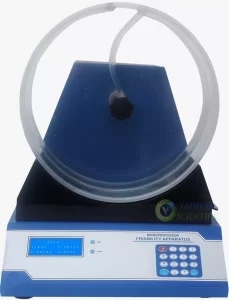
At the heart of the apparatus is a transparent rotating drum, usually made of acrylic. Inside the drum is a curved baffle.
The Motion
As the drum rotates, tablets are lifted and allowed to fall from a fixed height, repeatedly colliding with the drum surface and with each other.
The Test Cycle
A microprocessor controls:
-
Number of rotations
-
Rotation speed
-
Test duration
This precision ensures consistent stress is applied every time.
The Measurement
Tablets are weighed before and after testing. The percentage weight loss indicates friability.
The Role of the Microprocessor
The microprocessor is what transforms friability testing into a modern, reliable process.
It enables:
-
Accurate control of rotation count
-
Digital speed regulation
-
Clear display of test parameters
-
Reduced operator variability
-
Repeatable test conditions
For U.S. pharmaceutical manufacturers, this level of control supports data integrity and confidence in results.
Why Precision Matters in the USA
Pharmaceutical products in the United States are distributed on a massive scale. A minor mechanical weakness can become a nationwide problem.
Microprocessor-controlled friability testing ensures:
-
Batch-to-batch consistency
-
Reduced product recalls
-
Strong brand reputation
-
Patient confidence
It is a small test with a large impact.
Tablets Put to the Test
Friability testing is typically applied to:
-
Uncoated tablets
-
Film-coated tablets
-
Certain modified-release forms
Each formulation behaves differently under stress, making friability testing essential during formulation optimization.
Friability vs Hardness: A Crucial Difference
Friability and hardness are often confused, but they are not the same.
-
Hardness measures resistance to crushing force
-
Friability measures resistance to surface abrasion and impact
A tablet can be hard yet friable—or soft but durable. Only friability testing reveals how a tablet behaves during handling.
Inside a U.S. Pharmaceutical Manufacturing Facility
In American manufacturing plants, friability testing is often performed:
-
During formulation development
-
After compression parameter changes
-
As part of routine batch release testing
The microprocessor friability tester fits seamlessly into fast-paced quality control workflows.
Design Features of Modern Apparatuses
Today’s microprocessor friability test apparatuses are designed with both performance and usability in mind.
Common features include:
-
Digital control panels
-
Programmable rotation counts
-
Smooth, easy-to-clean drums
-
Quiet and stable operation
-
Compact bench-top design
These features support efficiency and reliability in busy U.S. labs.
Operator Confidence and Ease of Use
Laboratory professionals value equipment that works intuitively.
Microprocessor-based systems:
-
Reduce setup errors
-
Minimize manual calculations
-
Improve repeatability
-
Shorten training time
When results matter, ease of use builds trust.
Data Integrity and Documentation
In regulated environments, test results must be defensible.
Digital friability testers support:
-
Clear test parameter documentation
-
Consistent test execution
-
Reduced transcription errors
This aligns with modern expectations for laboratory data management in the United States.
Maintenance and Reliability
A friability test apparatus is a long-term investment.
Routine maintenance includes:
-
Cleaning the drum after each test
-
Verifying rotation accuracy
-
Inspecting mechanical components
With proper care, the instrument delivers years of dependable service.
Supporting Innovation in Tablet Design
Friability testing is not just about passing limits.
Formulation scientists use it to:
-
Compare excipient blends
-
Optimize compression force
-
Improve coating performance
-
Enhance patient experience
Durable tablets travel better, look better, and perform better.
Sustainability and Reduced Waste
By identifying weak formulations early, friability testing reduces:
-
Batch rejections
-
Product waste
-
Resource loss
This supports sustainability goals increasingly valued by U.S. pharmaceutical companies.
The Human Impact of Reliable Tablets
Patients may never think about friability, but they experience its benefits.
-
Tablets that don’t crumble
-
Accurate dosing every time
-
Clean packaging
-
Professional appearance
Behind that confidence stands a quiet test performed in a rotating drum.
The Future of Friability Testing
As laboratories modernize, friability testing continues to evolve.
Emerging trends include:
-
Enhanced digital interfaces
-
Integration with laboratory systems
-
Improved automation
Yet the principle remains unchanged: testing how tablets behave when the world is not gentle.
Frequently Asked Questions (FAQs)
What is friability testing used for?
It measures a tablet’s resistance to chipping, abrasion, and breakage during handling.
Why is a microprocessor important in friability testing?
It ensures precise control, repeatability, and reliable test conditions.
Are coated tablets tested for friability?
Yes, especially to evaluate coating durability during handling and transport.
How long does a friability test take?
Most tests are completed within a few minutes, depending on rotation settings.
Can friability testing replace hardness testing?
No. Both tests evaluate different mechanical properties and are used together.
Is friability testing destructive?
Yes, the tested tablets are not reused after the test.
Final Thoughts
The Microprocessor Friability Test Apparatus may never leave the laboratory, but its influence travels far.
It ensures that tablets manufactured in the United States arrive intact, consistent, and trustworthy—no matter how long the journey or how many hands they pass through.
In the gentle tumble of tablets inside a rotating drum, science safeguards reliability. And in that reliability, patients find confidence, one dose at a time.
What's Your Reaction?