How to Consolidate MRO Data Across Enterprise Systems
Learn how to consolidate fragmented MRO data into a unified master record — the framework, outcomes, and strategic case for asset-intensive operations.
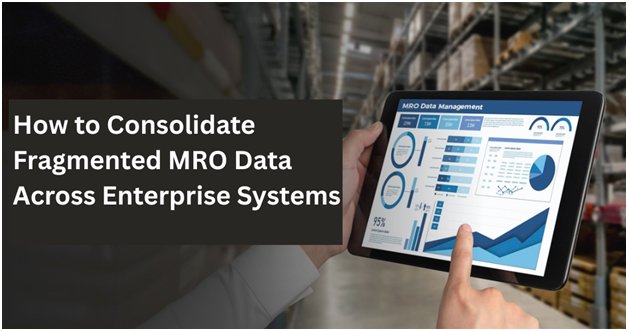
In asset-intensive operations, MRO data is the most referenced and least governed dataset in the enterprise. Item masters, supplier records, and asset bills of material drive every procurement transaction, work order, and maintenance schedule — yet they sit fragmented across ERP, CMMS, EAM, WMS, and supplier catalogs that were never designed to share data as a single source of truth.
The result is operational drag. Duplicate purchases, mismatched part numbers, inventory positions that no two functions can agree on, and reporting that arrives too late to inform decisions. Consolidating fragmented MRO data is the foundational fix. It is also the work on which most ERP migrations, sourcing initiatives, and reliability programs depend, but which is rarely completed in full.
This article examines the sources of MRO data fragmentation, the step-by-step process for consolidating it, the operational efficiency outcomes that follow, and how MRO data management services accelerate the process.
The Gap: Fragmented MRO Data Across Enterprise Systems
1. Decentralized Purchasing & Operations
Each plant or business unit historically creates its own part codes, descriptions, and supplier relationships. The same component picks up different identifiers at every site — sometimes different identifiers at the same site, across different buyers. There is no enterprise-level convention to consolidate against until one is deliberately built.
2. Mergers, Acquisitions, and ERP Migrations
Every acquisition imports its own item master, vendor master, and classification scheme into the parent organization. ERP migrations carry the same records forward without cleanup, because cleanup is rarely included in the migration budget. The result is sedimentary layers of historical data that no single team owns.
3. Free-Text Descriptions and Inconsistent Conventions
ERPs accept descriptions in whatever format the buyer types. "2 HP gear pump, cast iron" and "pump, gear, 2hp" become separate records. Without enforced noun-modifier conventions and attribute schemas, every duplicate is indistinguishable from a legitimate new record.
4. Disconnected Vendor and Asset Hierarchies
Vendor masters proliferate alongside item masters. The same supplier appears under three different vendor codes — one per plant that onboarded them. Asset bills of material reference part numbers that may or may not still exist in the current item master. None of these relationships is formally maintained without a governance layer.
How to Consolidate MRO Data Across Enterprise Systems
1. Conduct a Baseline Data Audit
Pull a complete inventory of MRO records from every source system: ERP item masters, CMMS asset records, EAM spare-part lists, WMS stock positions, vendor catalogs, and legacy spreadsheets. Measure duplication rates, completeness rates, classification coverage, and the percentage of records mapped to a parent asset. The baseline numbers anchor every business case and milestone that follows.
2. Establish the Master Data Model and Classification Standards
Define a master model that governs all MRO records across enterprise systems. The model covers;
➔ A noun-modifier-attribute schema for every item description
➔ A standardized classification taxonomy (UNSPSC, ECLASS, or ISO 8000) applied uniformly across plants
➔ Mandatory attribute sets defined per item category
➔ Cross-references to parent assets, suppliers, and active contracts
3. Centralize into a Single Master Repository
Establish a master data layer that sits above the transactional systems and feeds them. The repository holds the canonical record for every item, supplier, and asset. ERP, CMMS, EAM, and WMS subscribe to the master, not the other way around. Without centralization at the master data layer, downstream systems revert to fragmented record states over time.
4. MRO Data Cleansing and Enrichment
Apply structured deduplication, attribute enrichment, description normalization, and obsolete-record retirement against the target data model. Prioritize remediation by business impact:
● Critical spares and assets directly tied to production uptime
● High-consumption categories with significant spend exposure
● Records flagged in the active ERP migration scope
● Items linked to supplier contracts are up for renegotiation
Process lower-risk, high-volume categories in batches. Reserve subject-matter expert review for critical spares, regulated items, and ambiguous records where misclassification carries an operational or safety risk.
5. Establish Governance and System Integration
Cleansed data degrades quickly without governance. Define:
● Record-creation rules and mandatory attribute sets are enforced at the point of entry
● Approval workflows with assigned data stewards for each item category
● Synchronized integration between the master repository and every downstream system
● Change-control procedures for adding, modifying, or retiring records
6. Sustain with KPI Monitoring
Track completeness, accuracy, consistency, duplication rates, and classification coverage on a monthly or quarterly cycle. Measurable KPIs convert data quality from a subjective concern into an auditable operational metric — and surface data drift before it compounds into the next consolidation crisis.
Where Consolidated MRO Data Drives Operational Value
1. Procurement and Strategic Sourcing
With one description per part and a unified vendor master, category managers see total demand at the SKU, family, and supplier level. Volume aggregates across plants. Supplier rationalization becomes feasible. Strategic sourcing replaces reactive purchasing, and contract compliance becomes enforceable at the requisition level.
2. Inventory and Working Capital
Deduplicated SKUs reveal dead stock that can be liquidated or transferred. Cross-plant stock visibility eliminates redundant purchases of items already held elsewhere. Reorder points recalibrate against actual consumption rather than historical assumptions. Working capital previously tied up in duplicate inventory returns to operations. Therefore, MRO data management enables predictive maintenance through optimized inventory.
3. Maintenance and Reliability
Part-to-asset linkage means every work order references the correct SKU. Planners schedule against verified part availability. Technicians stop spending shift hours validating descriptions or searching for cross-references. Mean time to repair (MTTR) drops, and maintenance planning runs on consumption data that the team can trust.
4. Cross-Functional Reporting and Compliance
Finance, procurement, reliability, and operations work from the same master record. Spend reports, supplier scorecards, and reliability analyses reconcile to a single source of truth. Compliance and audit reporting becomes traceable across systems rather than reconstructed from fragmented sources.
The Strategic Case for MRO Data Consolidation
MRO data consolidation is foundational to every spend, inventory, reliability, and ERP migration initiative on the operations roadmap — and execution at enterprise scale is where most in-house programs run into capacity constraints.
Most in-house teams lack the dedicated MRO domain expertise and the operational capacity to consolidate fragmented data across ERP, EAM, CMMS, WMS, and supplier catalogs at enterprise volume. Specialized MRO master data management service providers close the gap by combining industry-specific subject matter experts, OEM-backed validation, and standards-based classification (UNSPSC, ECLASS, or ISO 8000) within a defined framework for assessment, cleansing, enrichment, and ongoing governance. The outcome is a consolidated master data set that remains standardized and reliable across the enterprise, while internal teams remain focused on uptime, maintenance execution, and operational performance.
Author Bio:
Eliana Wilson is an experienced eCommerce consultant at Data4eCom, a leading outsourcing agency providing end-to-end eCommerce services, with a strong background in multi-channel selling, digital marketing, and product data management. She works closely with brands and online retailers to streamline operations, enhance visibility, and scale revenue across platforms, such as Amazon, Walmart, and eBay. Her expertise spans product listing optimization, marketplace compliance, eCommerce PPC, and catalog management. Eliana regularly shares insights to help businesses overcome growth challenges and stay competitive.
What's Your Reaction?