Rotator Machine: The Laboratory Apparatus That Will Make Sure Your Samples Will Be Mixed Correctly
Rotator machine holds your tubes, plates or bags at an angle and rotates them smoothly so as to achieve correct mixing and avoid settling, formation of clots or separation of reagents.
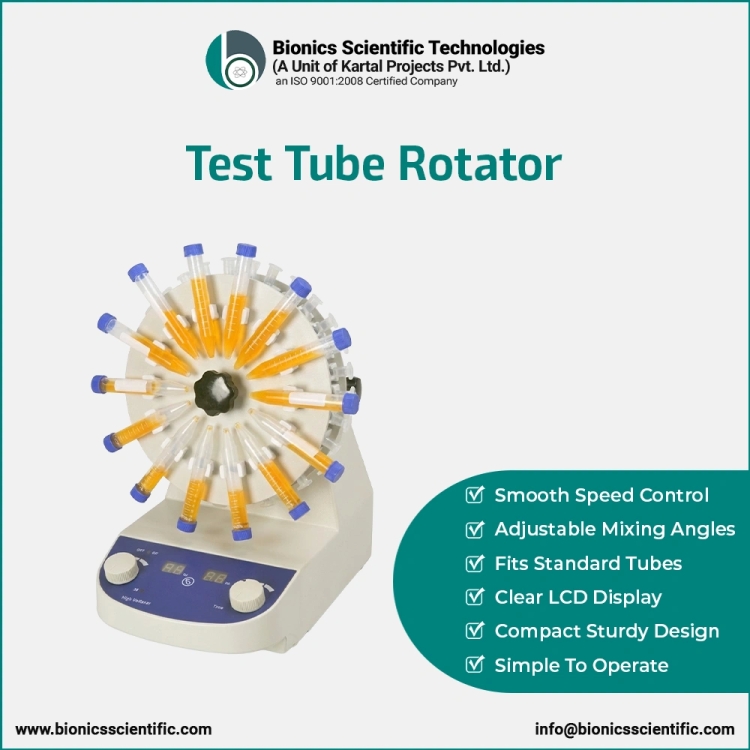
Those people who work in laboratories, be it blood bank or a research laboratory, know of the existence of a rotator machine and its role in the lab procedures, but cannot appreciate its importance unless there is a problem with mixing of sample and failure of the entire testing process due to that.
The Way the Rotator Machine Does Its Work
What does a rotator machine do? Rotator machine holds your tubes, plates or bags at an angle and rotates them smoothly so as to achieve correct mixing and avoid settling, formation of clots or separation of reagents. Unlike vortex machine that mixes your samples vigorously for several seconds, rotator does the same in a smooth way.
Uses in Laboratory
Blood Banks and Transfusion Services
Gentle rotation of blood bags is very important in ensuring that there are no aggregates formed, as well as proper suspension of the cells in the bag during storage and testing. The rotations in the blood bank have been properly calibrated to ensure that there is consistent and controlled speed so as to prevent cell aggregation while still protecting the cells.
Serology and Immunohematology
Tests like VDRL and RPR require circular rotation for there to be even reaction between the antigen and antibody. Proper rotation of the test sample is necessary to avoid a false negative or weak positive result, thus making the calibration of the rotator an important factor.
General Uses in Mixtures of Samples and Reagents
There are various techniques in molecular biology which involve continuous rotation of samples when incubating the reagents.
Key Features Differentiating an Excellent Rotator Machine from a Bad One
Adjustable Speed and Tilt Angle
Since various processes demand certain speeds of rotation and tilt angles, an excellent rotator machine that can adjust both speed and angle can get the work done in blood banks, serology, and other regular laboratory processes without having to use special machines for each process.
Long Time Motor Operation
Since most of the processes demand operation for extended periods of time, it is the performance of the motor for a long period of time that is more important than its peak speed.
Capacity for Handling Samples
Since a rotator machine that can handle small samples becomes a limitation when it comes to performing processes on bigger samples like blood bags, you can save yourself from any unnecessary expenses by checking the capacity of your machine.
Common Mistakes Laboratories Make in the Use of Rotator Machines
One of the common mistakes that laboratories make in the use of rotator machines which make the rotators wear out quickly and cause uneven mixing is using tubes or bags that do not match the rotator machine size. One of the most common mistakes that laboratories make when using rotator machines is failing to calibrate for speed on a regular basis as the machine does not
rotate at the required speed after some time and thus makes the results inaccurate.
How to Choose the Best Rotator Machine for Your Laboratory
As far as choosing the best rotator machine for your laboratory, begin with finding out what type of rotator machine is suitable for the purpose of use in your laboratory. There are rotator machines which are for blood bank purposes, some for serology while others are for tube rotator machines.
Final Thought
It may seem that rotator machines are very simple laboratory instruments but they play a big role in rotation which affects the accuracy of tests in laboratories.
1. What is a Rotator Machine?
A Rotator Machine is laboratory equipment used to rotate, mix, or agitate samples at a controlled speed. It is commonly used for applications where gentle and uniform mixing is required.
2. What is the main purpose of a Rotator Machine?
The main purpose is to provide controlled rotation and consistent mixing of samples without requiring manual agitation.
3. Where is a Rotator Machine used?
Rotator Machines are commonly used in laboratories, research facilities, pharmaceutical industries, biotechnology laboratories, chemical laboratories and testing facilities.
4. What types of samples can be used in a Rotator Machine?
Depending on the machine design, it can be used for different laboratory samples, solutions, chemicals and other materials that require controlled rotation or mixing.
5. How does a laboratory Rotator Machine work?
The machine rotates sample containers around a fixed axis at a selected speed. This movement helps create uniform mixing or agitation of the sample.
6. What are the benefits of using a Rotator Machine?
Key benefits include:
- Consistent sample mixing
- Controlled rotation speed
- Reduced manual effort
- Repeatable laboratory results
- Easy operation
- Suitable for continuous laboratory use
7. Is a Rotator Machine easy to operate?
Yes. Most laboratory rotators are designed with simple controls for setting operating parameters such as rotation speed and operating time, depending on the model.
8. Can the rotation speed be adjusted?
Yes. Many models provide adjustable rotation speed, allowing users to select an appropriate speed for their particular application.
9. What should I consider when buying a Rotator Machine?
Consider factors such as speed range, capacity, platform or tube compatibility, timer, construction material, dimensions, power requirements and application requirements.
10. Is a Rotator Machine suitable for pharmaceutical laboratories?
Yes. Laboratory rotators can be useful in pharmaceutical and research environments for applications requiring controlled sample mixing or rotation.
11. What materials are commonly used to manufacture Rotator Machines?
Laboratory rotators may use materials such as stainless steel, powder-coated metal and durable engineering plastics, depending on the model and application.
12. Does a Rotator Machine require regular maintenance?
Routine maintenance generally includes cleaning the equipment, checking moving components, inspecting electrical connections and following the manufacturer's maintenance instructions.
13. How can I choose the right Rotator Machine for my laboratory?
Select a model based on your sample type, container size, required capacity, rotation speed, operating time and laboratory application.
14. Can Rotator Machines be customized?
Depending on the manufacturer, customization may be available for requirements such as capacity, platform configuration, speed range and other operating specifications.
15. Where can I buy a Rotator Machine?
You can purchase a Rotator Machine from a reliable laboratory equipment manufacturer or supplier. Before purchasing, compare technical specifications, build quality, warranty and after-sales support.
What's Your Reaction?