Microprocessor Tablet Dissolution Test Apparatus
Tablet dissolution testing ensures that every dose behaves as intended inside the human body. In the USA, where healthcare standards are high and patient expectations even higher, dissolution testing is a cornerstone of pharmaceutical quality.
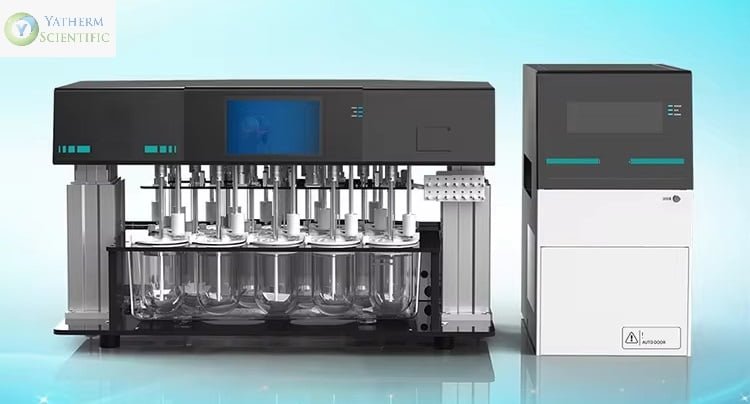
Microprocessor Tablet Dissolution Test Apparatus: Where Every Tablet Proves Its Promise
Why Dissolution Matters More Than Most People Realize
Imagine swallowing a tablet prescribed to control blood pressure. You trust that the medicine inside will dissolve at the right speed, release the correct amount of active ingredient, and enter your bloodstream effectively.
If it dissolves too fast, it could cause side effects. If it dissolves too slowly, it might not work at all.
This balance is everything.
Tablet dissolution testing ensures that every dose behaves as intended inside the human body. In the USA, where healthcare standards are high and patient expectations even higher, dissolution testing is a cornerstone of pharmaceutical quality.
What Is a Microprocessor Tablet Dissolution Test Apparatus?
A Microprocessor Tablet Dissolution Test Apparatus is an advanced laboratory instrument designed to measure how quickly and how completely a tablet or capsule dissolves in a liquid medium under controlled conditions.
The inclusion of a microprocessor brings precision, automation, and repeatability to the testing process. It allows laboratories to control parameters digitally and record results accurately.
In simple terms, it simulates what happens to a tablet once it enters the human digestive system — but under carefully monitored laboratory conditions.
From Manual Testing to Intelligent Automation
Years ago, dissolution testing involved manual monitoring, stopwatches, and handwritten records. While effective at small scale, this approach left room for inconsistency.
As pharmaceutical production in the United States grew more complex and large-scale, laboratories demanded:
-
Greater accuracy
-
Consistent test conditions
-
Digital control
-
Reliable data storage
The microprocessor-based dissolution apparatus emerged as the answer — combining science with smart automation.
How the Apparatus Works: Science in Motion
At first glance, the apparatus may appear straightforward: a set of vessels, paddles or baskets, and a heating system. But beneath the surface lies sophisticated control.
A typical dissolution test involves:
1. Preparation of the Medium
The vessels are filled with a specific liquid that mimics bodily fluids. Temperature is maintained precisely, often close to human body temperature.
2. Placement of the Tablet
The tablet or capsule is placed into each vessel under standardized conditions.
3. Controlled Agitation
Paddles or baskets rotate at a pre-set speed controlled by the microprocessor. This simulates natural movement within the digestive system.
4. Time Monitoring
The microprocessor tracks elapsed time with precision, ensuring consistency across tests.
5. Sampling and Analysis
Samples are withdrawn at specific intervals to measure how much of the drug has dissolved.
Throughout the process, the system maintains stable conditions and records key data points.
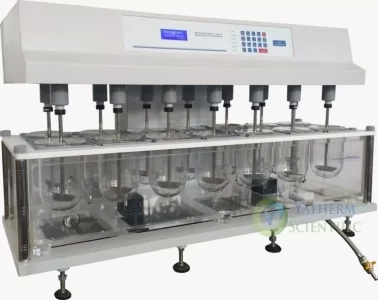
The Role of the Microprocessor: Precision Without Guesswork
The microprocessor is the brain of the apparatus.
It allows operators to:
-
Set exact rotation speeds
-
Control temperature digitally
-
Program test durations
-
Run multiple tests consistently
-
Reduce manual intervention
For U.S. pharmaceutical labs operating under strict quality expectations, this level of control is essential.
Applications Across the U.S. Pharmaceutical Industry
Drug Development and Research
During formulation development, scientists test different compositions to understand how changes affect dissolution. The apparatus provides reliable data that guides decision-making.
Quality Control Laboratories
In manufacturing facilities, dissolution testing ensures that each batch meets established performance standards before reaching the market.
Generic Drug Manufacturing
For generic drugs, matching the dissolution profile of the original product is critical. Microprocessor-based testing supports accurate comparisons.
Academic and Research Institutions
Universities and research labs across the USA use dissolution apparatuses for teaching, experimentation, and innovation.
Why U.S. Laboratories Depend on Digital Control
In the United States, pharmaceutical quality is closely tied to documentation and consistency.
Digital control ensures:
-
Repeatable test conditions
-
Clear result visibility
-
Reduced operator variability
-
Easy review of test parameters
This reliability supports confident decision-making at every level.
User-Friendly Design for Modern Labs
Despite its technical sophistication, the Microprocessor Tablet Dissolution Test Apparatus is designed with usability in mind.
Features often include:
-
Clear digital displays
-
Simple parameter input
-
Alarm indicators for deviations
-
Easy cleaning and maintenance
This balance between advanced technology and ease of use is especially valuable in busy American laboratories.
Supporting Efficiency and Productivity
Automation saves time.
With microprocessor control:
-
Multiple tests can run simultaneously
-
Manual monitoring is minimized
-
Results are more consistent
-
Laboratory throughput increases
This efficiency supports faster product release without compromising quality.
Data Integrity and Confidence
Accurate dissolution data builds confidence — not just internally, but across the entire supply chain.
Manufacturers, healthcare providers, and patients all benefit when tablets perform exactly as intended.
The apparatus helps ensure that confidence.
The Human Impact of Dissolution Testing
Behind every test is a patient waiting for relief, stability, or healing.
The scientist running the dissolution test understands that precision matters. The quality manager reviewing the data knows that consistency saves lives. The manufacturer shipping the product trusts the numbers.
The Microprocessor Tablet Dissolution Test Apparatus connects all of them.
Choosing the Right Dissolution Apparatus
When selecting an apparatus, U.S. laboratories typically consider:
-
Number of test stations
-
Digital accuracy
-
Ease of calibration
-
Long-term reliability
-
Technical support availability
The goal is not just compliance, but confidence.
The Future of Dissolution Testing
As drug formulations evolve — including modified-release and personalized medicines — dissolution testing will continue to advance.
Future systems may offer:
-
Enhanced automation
-
Integrated data management
-
Smarter controls
-
Greater flexibility
But the purpose will remain the same: ensuring medicine works as promised.
Frequently Asked Questions (FAQs)
What is a Microprocessor Tablet Dissolution Test Apparatus used for?
It is used to determine how quickly and completely tablets or capsules dissolve under controlled laboratory conditions.
Why is dissolution testing important?
Because it ensures consistent drug release, effectiveness, and patient safety.
How does microprocessor control improve testing?
It provides precise control, repeatability, and reduces human error.
Who uses dissolution test apparatuses in the USA?
Pharmaceutical manufacturers, research labs, and academic institutions.
Is the apparatus difficult to operate?
No. It is designed to be user-friendly with basic laboratory training.
Can it test different types of tablets?
Yes. It is suitable for a wide range of solid dosage forms.
Final Thoughts: Trust Measured in Minutes
A tablet’s journey does not end when it is pressed and packaged. Its true test begins when it meets liquid, motion, and time.
The Microprocessor Tablet Dissolution Test Apparatus ensures that journey unfolds exactly as intended — not once, but every time.
In laboratories across the United States, it quietly transforms science into trust, data into confidence, and small tablets into reliable medicine.
And in doing so, it helps ensure that when a patient swallows a pill, it delivers not just medicine — but assurance.
What's Your Reaction?