How AI Is Transforming UI/UX Design Around User Intent
UI UX agency was focusing on pre-defined navigation with fixed menus, typical search bars, and user journeys based on manual analysis.
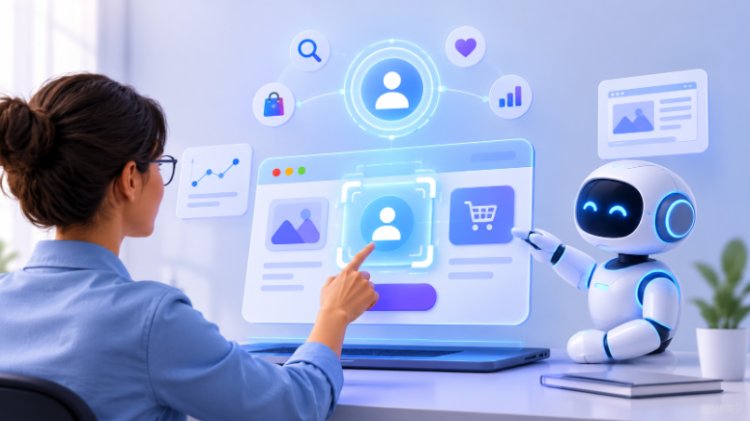
“Netflix always knows what you wish to watch. Amazon suggests products as you browse its website or app. Spotify comes up with a playlist that feels like it is made for you only.”
And these aren't just lucky guesses. It’s a great piece of work done using AI in UI/UX design. AI has significantly changed the way many sectors were working, and UI/UX design services in India are no longer an exception in it.
AI is no longer just a tool – it has become a creative partner and quiet revolution reshaping how a web design company India can build and scale the digital experience. And the heart of this revolution is not just about creating something visually appealing, but it is more about designing interfaces that feel tailored for each one, adapting to their needs, considering their preferences, and even the context of the users interacting.
In this blog post, we’ll explore how AI is revolutionizing the leading UI/UX design services, empowering designers, and eventually reshaping how businesses can use it to make digital journeys more relevant, engaging, and effortless for their target audience.
5 Ways AI is Transforming UI/UX Design Today.
● AI-Powered Personalization for Better User Experiences
Before AI:
In the past, one of the major challenges for the UI UX agency was to create user experiences that are connected to the target audience and make them feel personalized to each user. The design team had to consider various user personas and even rely on assumptions to make it work.
After AI:
AI has changed the way of enabling personalization. It analyses real-time user data – including clicks, searches, and user behaviors through deep learning – and dynamically adjusts the UI elements based on the same. This in the end increases user engagement, enhances accessibility, and boosts user retention as the more intuitive and tailored the UI feels, the chances are less users will abandon the platform.
● Intent-Based Navigation for Easier User Journeys
Before AI:
Traditionally, UI UX agency was focusing on pre-defined navigation with fixed menus, typical search bars, and user journeys based on manual analysis. Designers spent a lot of time understanding how users would interact and crafting navigation according to their best judgment, while users were expected to understand application structure and navigate on their own to fulfil their task.
After AI:
AI has shifted this approach to intent-based navigation, where interfaces are designed around what users want to complete in the application rather than forcing them to navigate through features located. It can enable:
o Intent-driven interfaces showing relevant actions and information for the users.
o Flexible journeys accommodating different user intents.
o Simplifying the workflows by bringing relevant information and steps together.
o Understanding contextual signals and user interaction patterns and adapting them.
It is necessary to make a note that intent-based navigation will be ruling the future, but cannot replace traditional navigation.
● Improve UI/UX Accessibility with AI
Before AI:
Earlier, accessibility testing heavily relied on manual reviews, predefined checklists, and a small set of testing tools. A web design company India had to identify issues such as missing color contrast, heading structure inconsistencies, navigation issues, and alternate text issues via separate checks.
After AI:
With the help of AI, accessibility checks become more proactive. The designers can easily identify potential usability and accessibility issues earlier and can address them before even development is completed. There are various tools available that can help with:
o Suggestions for improving color contrasts
o Identifying missing labels in elements and alternative text
o Highlighting potential accessibility issues.
While accessibility is shifting from a manual activity towards a continuous process for UI/UX improvement, it is crucial to understand that AI checks cannot bypass accessibility standards and required testing.
● Conversational & Voice-based Assistants
Before AI:
The traditional UI/UX practices involved designing graphics and layouts, including various interactive elements like buttons, menus, or forms. The earlier design approach was more focused on designing elements that are engaging and can be used without any difficulty by the users.
After AI:
Today, user interfaces of applications have become more human-like with the help of conversational interactions. Designing conversational and voice-based user interfaces requires leading UI/UX design service providers to think beyond traditional screens and design approaches. Engaging chat interfaces and voice-based interactions enable better understanding of user intent and lead to more relevant and contextual responses.
It reduces friction for users with complex interfaces through natural interaction. Moreover, voice-based assistance can be a good alternative for disabled people to interact with the business. Siri, Alexa, or Google Assistant are not just there for fun; in fact, they are the enablers for seamless and human-like interactions of the future.
● AI-Powered Content Optimization for UI/UX
Before AI:
Design is not just about visual elements – the content on the screen also matters a lot. Content creation and optimization required a lot of research, structured content, keyword analysis, and proofreading. The design team and content creators used to spend significant time on interface content, labels, and images or visuals. Also, providing personalized content for different users required additional time.
After AI:
AI has introduced a more dynamic and context-aware approach. With the help of various tools, it has become easy to generate and refine the content. With tools like GrammarlyGo or Jasper AI, writing context-based microcopy for buttons, screens, and other interface elements has gotten much easier. These tools can analyze how users interact with content. This makes the experience smoother for users.
Business Benefits of Using AI in UI/UX Design
● Faster turnaround time for the design of wireframes and prototypes. Tasks that were taking almost a month can now be completed within a few days.
● Automate the typical repetitive design tasks and focus more on other aspects.
● Businesses can get interactive prototypes and user flows based on structured descriptions from AI tools.
● Reduce human errors in large design teams.
Closing Notes
The impact of AI in the UI/UX design is apparent and visible. It has transformed the design process by automating various monotonous activities, including prototype designing, wireframing, and content creation, and brings a whole host of powerful tools to automate UI/UX design services in India.
The design team can now deliver much faster, flawless, and immersive user interfaces while providing value to the clients. Its ability to analyze user data, design high-quality visuals, and automate workflows has shifted the paradigm of design to creative implementation.
While AI brings opportunities for UI/UX design to grow a lot, it is also important to think about the ethical challenges of privacy. Remember, designing with AI can be very profitable. It also needs a human‑first approach. That way, technology can improve experiences without taking advantage of people.
What's Your Reaction?