Best Practices for Email List Maintenance & Validation
A practical, sales-focused guide to keeping your email database healthy. This article breaks down the best practices for email list maintenance, explains why it's important, and shows how email list validation, a reliable email verification service, and purpose-built B2B email verification solutions protect your sender reputation and boost campaign ROI.
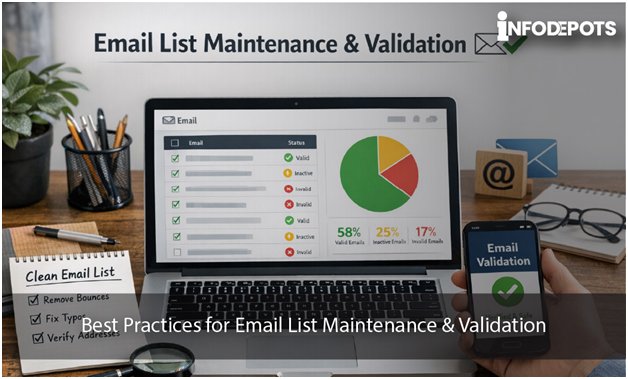
Your email list is one of the most valuable assets your business owns—but only if it's clean. A bloated database packed with stale, invalid, or fake addresses doesn't just waste your marketing budget; it quietly drags down your sender reputation, inflates your bounce rates, and lands your campaigns in the spam folder. That's why smart marketers treat list hygiene as an ongoing discipline, not a once-a-year chore.
Let's walk through the best practices for email list maintenance that keep your campaigns sharp, your deliverability high, and your ROI climbing.
"Your email list isn't a trophy to collect—it's a garden to tend. Neglect it, and the weeds take over."
Why Is Email List Maintenance Important?
This is the question that strikes up most teams, so let's answer it head-on. Why is email list maintenance important? Because email service providers (ESPs) and inbox algorithms judge you by the company you keep. Every time you send dead addresses, spam traps, or disengaged contacts, you signal to Gmail, Outlook, and Yahoo that you might be a careless sender.
The consequences add up fast:
- Higher bounce rates that flag your domain as risky
- Lower inbox placement, meaning even your engaged subscribers stop seeing you
- Wasted spend on contacts who will never open, click, or buy
- Damaged sender reputation that can take months to rebuild
Consistent email list maintenance flips that script. A clean list tells mailbox providers you're a trustworthy sender—and that trust translates directly into more eyes on your message and more revenue in your pipeline.
What Is Email List Validation?
Email list validation is the process of verifying that every address on your list is real, active, and capable of receiving mail—before you hit send. Think of it as a quality checkpoint that catches problems while they're still cheap to fix.
A thorough validation process typically checks for:
- Syntax errors – malformed addresses like missing "@" symbols or typos
- Domain validity – confirming the domain exists and accepts mail
- Mailbox existence – pinging the server to verify the inbox is live
- Disposable and role-based addresses – flagging temporary inboxes and generic ones like info@ or sales@
- Spam traps and known complainers – removing addresses that can torpedo your reputation
When you run email list validation regularly, you stop bad data at the door instead of paying for it later in lost deliverability.
Best Practices for Email List Maintenance
Here's the practical playbook. Adopt these best practices for email list maintenance, and you'll see measurable gains in engagement and inbox placement.
1. Validate at the point of capture. The cleanest list is one that never lets bad data in. Add real-time verification to your sign-up forms so typos and fake addresses get caught instantly.
2. Clean on a schedule. Don't wait for bounce rates to spike. Run a full email list maintenance sweep every quarter—monthly if you send high volumes or operate in fast-moving B2B markets.
3. Segment by engagement. Group contacts by how recently they opened or clicked. This lets you re-engage the lukewarm and quietly retire the truly dormant.
4. Run a re-engagement campaign before you delete. Give inactive subscribers one last compelling reason to stay. The ones who respond are gold; the ones who can’t be removed with confidence.
5. Honor unsubscribes immediately. Slow or buried opt-outs erode trust and invite spam complaints. Make leaving easy—it protects your reputation.
6. Monitor your metrics. Track bounce rate, open rate, and complaint rate over time. Sudden shifts are early warning signs that your list needs attention.
"Sending to a dirty list is like pouring water into a leaky bucket—you can keep pouring, but you'll never fill it."
How Often Should You Validate Your Email List?
This is a top trending question among marketers, and the honest answer is: it depends on how fast your data decays. On average, B2B email lists degrade by roughly a quarter every year as people change jobs, companies rebrand, and domains shut down.
A reliable rhythm looks like this:
- Real-time validation on every new sign-up
- Monthly checks for active, high-frequency senders
- Quarterly deep cleans for everyone else
- Pre-campaign verification before any major send
Stick to this cadence, and you'll never be blindsided by a sudden deliverability drop.
Choosing the Right Email Verification Service
Manual cleaning doesn't scale—and guessing is expensive. A dedicated email verification service automates the heavy lifting, scrubbing thousands of addresses in minutes with accuracy no spreadsheet can match.
When evaluating an email verification service, look for:
- High accuracy rates backed by real SMTP checks, not just guesswork
- Fast processing that handles bulk lists without slowing your workflow
- Clear result categories (valid, invalid, risky, catch-all) so you can act decisively
- API integration that plugs verification directly into your forms and CRM
- Transparent pricing with no surprise credit drains
For organizations selling to other businesses, B2B email verification solutions deserve special attention. Business inboxes behave differently than consumer ones—catch-all domains, strict firewalls, and role-based addresses are far more common. The best B2B email verification solutions are built to navigate these quirks, validating corporate addresses with precision so your sales and outreach teams reach real decision-makers, not dead ends.
Turn Clean Data into Real Revenue
Here's the bottom line: every dollar you invest in email list maintenance and email list validation pays you back in stronger deliverability, higher engagement, and a sender reputation that opens inboxes instead of spam folders. Pair disciplined habits with a proven email verification service—and B2B email verification solutions if you sell to businesses—and you transform a neglected list into a high-performing revenue engine.
Don't let bad data quietly cost you customers. Clean it, verify it, and watch your campaigns work harder for every send.
What's Your Reaction?