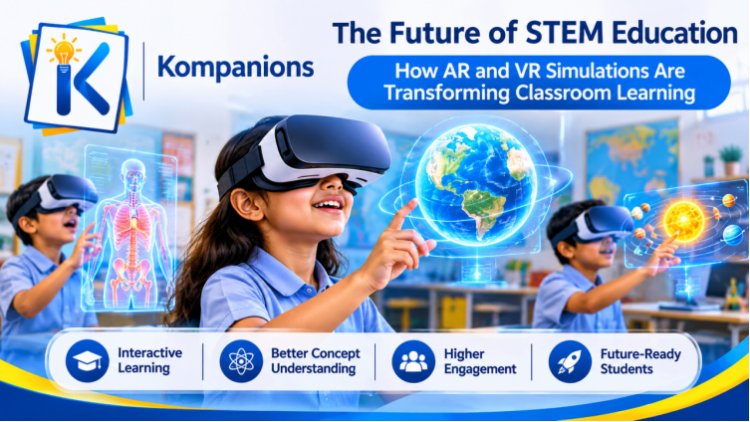
The Future of STEM Education: How AR and VR Simulations Are Transforming Classroom Learning
Virtual Reality creates a simulated environment where learners can explore digital spaces using VR-compatible headsets.
Science, technology, engineering, and mathematics are essential subjects for preparing students for the future. However, understanding complex concepts through textbooks and traditional classroom explanations can sometimes be challenging. Students may understand theoretical definitions but struggle to connect them with real-world applications.
This is where Augmented Reality (AR) and Virtual Reality (VR) are creating new opportunities in education. These immersive technologies allow students to explore concepts visually, interact with digital environments, and experience practical learning activities that go beyond conventional teaching methods.
Understanding AR and VR in Modern Education
Augmented Reality adds digital elements to the real world through compatible devices. Students can use AR applications to explore three-dimensional models, examine scientific structures, and understand subjects through interactive visual experiences.
Virtual Reality creates a simulated environment where learners can explore digital spaces using VR-compatible headsets. Instead of simply reading about a scientific process or engineering concept, students can experience a virtual representation of it.
Both technologies offer different ways to make classroom learning more engaging and practical.
Making Complex STEM Concepts Easier to Understand
Many STEM subjects involve concepts that are difficult to visualize. Topics such as the human circulatory system, molecular structures, planetary movements, and mechanical engineering often require students to imagine processes that cannot be directly observed.
AR and VR simulations can help bridge this gap.
For example, students studying the human body can explore three-dimensional anatomical models. Learners studying astronomy can examine the solar system through immersive visual environments. Similarly, engineering students can explore machine components and understand how different mechanisms function.
These experiences help connect theoretical knowledge with visual understanding.
Encouraging Practical Learning Through Simulations
Practical experience is an important part of STEM education. However, schools may face limitations related to laboratory equipment, available resources, safety requirements, and classroom space.
Virtual simulations provide another way to introduce practical learning activities.
Students can participate in virtual science experiments, explore engineering environments, and observe simulated processes. These activities allow learners to understand procedures and explore different outcomes in a controlled digital setting.
For example, a virtual chemistry simulation can help students understand laboratory procedures before performing experiments in a physical laboratory. Similarly, virtual engineering environments can introduce learners to equipment and technical processes.
Simulations should complement physical practical activities wherever hands-on experience is essential.
Improving Student Engagement and Active Participation
One of the biggest challenges in education is maintaining student interest while explaining complex subjects. Long theoretical explanations may not work equally well for every learner.
Interactive AR and VR activities introduce a more participatory approach. Students can explore objects, interact with virtual elements, and learn through guided activities instead of remaining passive listeners.
This approach can support:
● Better visual understanding of difficult concepts.
● Greater participation in classroom activities.
● Opportunities for exploration and experimentation.
● Collaborative learning experiences.
● More engaging ways to revise academic topics.
When students actively participate in learning activities, they get more opportunities to connect information with practical experiences.
How Schools Can Integrate AR and VR Into Their Curriculum
Introducing immersive technology does not require schools to completely replace their existing teaching methods. A gradual approach can help institutions understand where these tools provide the greatest educational value.
Here are some practical steps schools can consider:
1. Identify suitable subjects: Begin with subjects that benefit from visual demonstrations, such as biology, physics, chemistry, geography, and engineering.
2. Select curriculum-aligned simulations: Choose learning experiences that support existing academic objectives instead of introducing technology without a clear educational purpose.
3. Prepare teachers: Educators should understand how to operate the technology, guide students, and connect simulation activities with classroom lessons.
4. Start with focused activities: Introduce AR or VR through selected lessons before expanding its use across multiple subjects.
5. Evaluate learning outcomes: Collect feedback from teachers and students to understand whether the activities improve comprehension, participation, and classroom engagement.
Educational technology platforms such as Kompanions can be explored by institutions interested in bringing immersive learning experiences into their educational environments.
Challenges and Considerations Before Adoption
Although AR and VR offer valuable educational opportunities, schools should consider several factors before implementing them.
Device availability, infrastructure requirements, teacher training, accessibility, and content quality all influence the success of an immersive learning program.
Schools should also ensure that digital simulations are age-appropriate, curriculum-relevant, and easy for students to use. Screen time and student comfort should be considered when planning VR activities.
Most importantly, technology should support the learning process rather than become a distraction from educational objectives.
What Does the Future Hold for Immersive STEM Learning?
As educational technology continues to develop, AR and VR may become increasingly useful tools for explaining complex subjects and supporting experiential learning.
Future educational environments could combine traditional classroom instruction with interactive simulations, virtual experiments, and digital learning resources. This combination may provide students with more opportunities to explore academic concepts and develop practical understanding.
The goal is not to replace teachers or traditional education. It is to give educators additional ways to explain difficult topics and help students connect classroom knowledge with real-world applications.
Conclusion
AR and VR simulations are opening new possibilities for STEM education by making complex concepts easier to visualize and practical learning more accessible. When implemented thoughtfully, these technologies can support student engagement, encourage exploration, and strengthen the connection between theory and practice.
For schools looking to prepare students for a technology-driven future, immersive learning can be a valuable addition to a well-planned educational strategy.
About the Author
Kapil Saini is an SEO specialist interested in digital innovation, educational technology, and online content development. He focuses on creating informative content that helps readers understand emerging technologies and their practical applications.
What's Your Reaction?