From AMMs to Intent-Based Trading: The New Era of Decentralized Exchange Development
"Have you ever watched a promising trade fail not because your strategy was wrong but because the market moved before your transaction could execute?"
That frustration isn't unique.
A DeFi startup founder recently shared how their users kept complaining about failed swaps, unexpected slippage, and rising gas fees. The platform had strong liquidity, an attractive interface, and a growing community. Yet users quietly migrated elsewhere.
The problem wasn't the product.
The problem was that user expectations had changed.
Today's traders no longer want to manually compare pools, bridges, gas costs, and routing options. They simply want to say:
"This is the result I want."
And they expect the technology to handle everything else.
That shift is transforming the future of decentralized exchange development.
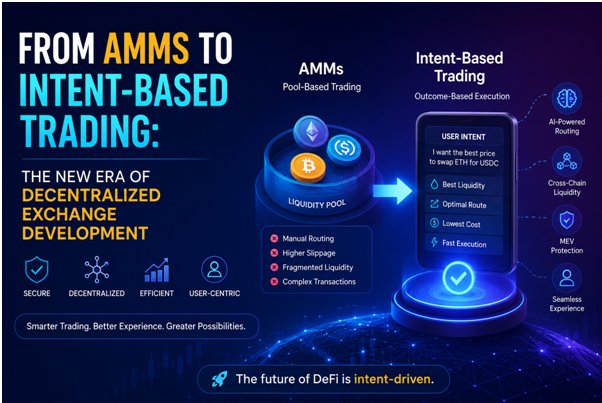
The industry has moved far beyond the first generation of automated market makers (AMMs). Today's decentralized exchanges are becoming intelligent trading ecosystems powered by intent-based execution, AI-assisted routing, cross-chain liquidity, account abstraction, and MEV protection.
As the famous business quote says,
"Innovation is no longer about building faster. It's about building smarter."
This article explores how decentralized exchange development is evolving, why intent-based trading is becoming the next major milestone in DeFi, and what businesses should consider before building the next generation of decentralized exchanges.
The Evolution of Decentralized Exchanges
The way people trade digital assets has changed dramatically over the past few years. In the early days of cryptocurrency, most trading happened on centralized exchanges, where users had to trust a third party to hold their funds and process transactions. While these platforms offered convenience to the user, they also introduced concerns about security, transparency, and control.
The rise of Decentralized exchange development changed that approach completely. Instead of relying on a central authority, decentralized exchanges (DEXs) allowed users to trade directly from their wallets. This gave traders full ownership of their assets while making crypto trading more transparent and accessible.
One of the biggest innovations that made this possible was the introduction of Automated Market Makers (AMMs). AMMs simplified trading and laid the foundation for the modern DeFi ecosystem.
The Early Days of AMMs
Automated Market Makers (AMMs) introduced a new way to trade cryptocurrencies without matching buyers and sellers. They made decentralized trading faster, easier, and more accessible.
Why Did AMMs Change Crypto Trading?
AMMs allowed users to trade anytime through liquidity pools, improving accessibility and making DeFi available to a wider audience.
Removing Traditional Order Books
Instead of using order books to match trades, AMMs automatically execute swaps through smart contracts, creating a smoother trading experience.
Peer-to-Pool Trading
With AMMs, users trade directly with a liquidity pool rather than another trader, ensuring faster and more efficient transactions.
Popular AMM Models
As decentralized finance evolved, developers introduced different AMM models to meet various trading needs.
● Constant Product AMM – The most widely used model, ideal for general token swaps and the foundation of many decentralized exchanges.
● Constant Sum AMM – Designed for assets with similar values, though it works best in limited scenarios.
● StableSwap AMM – Built specifically for stablecoins and assets with nearly identical prices, helping reduce slippage during trades.
● Hybrid AMM – Combines multiple pricing mechanisms to improve capital efficiency and support a wider range of digital assets.
Where do traditional AMMs begin to fall short?
While AMMs made decentralized trading easier, they are not without challenges. As the DeFi ecosystem grows, users expect faster, cheaper, and more efficient trading experiences.
● Slippage - The price of a token can change between the time you start and complete a trade. For example, you expect to receive 100 tokens but end up getting only 95 because the price mo
● Fragmented Liquidity – Liquidity is often spread across multiple blockchains and exchanges, making it difficult to find the best price in a single place.
● High Gas Fees - Network congestion can increase transaction costs. A small token swap may end up costing much more than expected because of high gas fees.
● Poor Routing - Some AMMs don't always choose the most efficient trading path, causing users to receive fewer tokens than they could through a better route.
● Impermanent Loss - Liquidity providers may earn trading fees, but price fluctuations can reduce the overall value of their deposited assets.
● MEV Attacks - Some bots monitor pending transactions and place their own trades first, causing users to pay more or receive fewer tokens than expected.
● Complex Cross-Chain Transactions - Moving assets between different blockchains often requires multiple steps, making the process slower and more confusing for users, especially beginners.
What is Intent-Based Trading?
Intent-based trading is a modern approach in which users tell the protocol what result they want, rather than how the trade should be executed.
In traditional decentralized exchanges, users must choose the trading route, liquidity pool, and other transaction settings themselves. With intent-based trading, those technical decisions are handled automatically by the protocol.
Example
Instead of manually selecting the swap path, a user simply says:
"I want to swap 5 ETH for the highest possible amount of USDC."
The protocol then finds the best way to complete the trade by automatically choosing:
● The most efficient trading route
● The best available liquidity
● The lowest possible gas fees
● The least amount of slippage
● The fastest execution path
Why It Matters ?
Intent-based trading makes decentralized trading easier, faster, and more efficient. Users only need to define their desired outcome, while the protocol optimizes every step behind the scenes. This reduces complexity, improves trade execution, and helps users receive better value without needing deep technical knowledge.
Why Is Intent-Based Trading Becoming the Future of DeFi?
Intent-based trading is changing how people interact with decentralized finance. Instead of asking users to manage complex trading steps, it focuses on delivering the best possible outcome automatically. Here are the key reasons why it is becoming the future of DeFi.
Better User Experience – Traditional DeFi trading often requires users to select trading routes, adjust settings, and understand complex protocols. Intent-based trading removes this complexity. Users only need to state what they want to achieve, making trading much simpler and more accessible for everyone.
Smarter Trade Execution – The protocol automatically analyzes multiple trading options and chooses the most efficient execution path. Optimizing the route in real time, it helps users receive better prices, lower slippage, and faster transaction completion without manual effort.
Cross-Chain Trading - Trading across different blockchains usually requires users to bridge assets before completing a swap. Intent-based trading simplifies this process by automatically handling cross-chain execution when supported, allowing users to trade across networks without managing multiple steps.
Reduced Transaction Costs - By selecting the most efficient execution route, intent-based trading helps reduce unnecessary gas fees and other transaction costs. Users benefit from a more cost-effective trading experience while avoiding inefficient swaps.
Improved Liquidity Access - Instead of relying on a single liquidity pool, intent-based trading can access liquidity from multiple protocols and blockchain ecosystems. This broader liquidity access increases the chances of finding better prices and smoother trade execution, especially for larger transactions.
Modern Technologies Transforming Decentralized Exchange Development
Modern DEX platforms are evolving beyond basic token swaps. New technologies are making decentralized exchanges faster, smarter, and easier to use while improving security and trading efficiency.
AI-Powered Routing - AI-powered routing analyzes multiple trading paths in real time to find the best execution. It helps users get better prices, lower slippage, and faster transactions without manually selecting a route.
Cross-Chain Liquidity – Instead of relying on liquidity from a single blockchain, modern DEXs can access liquidity across multiple networks. This improves trade execution and gives users access to more competitive pricing.
Account Abstraction - Account abstraction removes many of the technical barriers for new users. Features like gas fee flexibility, social logins, and simplified wallet management make decentralized trading easier for everyone.
MEV Protection - Modern DEXs use MEV protection to reduce the risk of front-running and sandwich attacks. This helps ensure users receive fair pricing and protects the value of their trades.
Solver Networks - Solver networks use off-chain algorithms to find the most efficient way to execute a trade. They compare multiple routes and liquidity sources before submitting the optimal transaction on-chain, improving speed and reducing costs.
AMMs vs Intent-Based Trading
|
AMMs |
Intent-Based Trading |
|
Manual routing |
Automatic optimization |
|
Pool-based execution |
Outcome-based execution |
|
Higher slippage |
Lower slippage |
|
Single-chain focus |
Cross-chain capable |
|
The user decides the path. |
The protocol decides the best path |
|
Limited optimization |
AI-assisted optimization |
Business Benefits of Next-Generation Decentralized Exchange Development
Focus on business value.
● Higher user retention
● Better trading efficiency
● Increased transaction volume
● Improved liquidity utilization
● Lower operational friction
● Competitive differentiation
● Greater scalability
Key Features Every Modern DEX Should Include
● Intent-based execution
● Smart order routing
● Cross-chain swaps
● AI-powered liquidity aggregation
● MEV protection
● Multi-wallet support
● Account abstraction
● Analytics dashboard
● DAO governance
● Institutional security
● Compliance-ready architecture
● Mobile-first experience
The Road Ahead
● The future of decentralized exchange development is focused on making trading smarter, faster, and easier. Here are the key trends shaping the next generation of DEXs.
● AI Agents – AI agents can analyze market conditions and help execute trades more efficiently with minimal user effort.
● Autonomous Trading – Trading strategies can run automatically based on predefined goals, reducing the need for constant manual monitoring.
● DeFi Automation - Routine tasks like token swaps, yield farming, and portfolio management can be automated to save time and improve efficiency.
● Intent-Centric Protocols – Instead of choosing how to trade, users simply state the outcome they want, and the protocol finds the best way to achieve it.
● Real-World Asset Integration – Assets like real estate, stocks, and commodities are being tokenized, bringing traditional investments into the DeFi ecosystem.
● Institutional DeFi Adoption – More financial institutions are exploring DeFi to improve trading efficiency, transparency, and asset management.
● Zero-Knowledge Privacy – Advanced cryptographic technology helps protect user data while allowing transactions to remain secure and verifiable.
● Unified Liquidity Layers - Liquidity from multiple blockchains is combined, helping users access better prices and smoother cross-chain trading.
Conclusion
The evolution of decentralized exchanges isn't simply about replacing one trading model with another. It's about creating an experience where technology quietly solves complexity for the user.
AMMs laid the foundation for permissionless trading and opened the doors to decentralized finance. But as the ecosystem matures, users expect more than access; they expect efficiency, speed, and intelligent execution.
Intent-based trading represents the next step. By allowing users to focus on their desired outcome instead of navigating multiple protocols, it transforms decentralized trading into a faster, simpler, and more intuitive experience.
For businesses, this evolution presents a clear opportunity. Building a decentralized exchange today means designing for the future, where AI-powered routing, cross-chain liquidity, account abstraction, and intelligent execution are becoming standard expectations rather than optional features.
As Warren Buffett once said:
"Price is what you pay. Value is what you get."
The same principle applies to decentralized exchange development. The platforms that deliver the greatest value through seamless user experiences and smarter infrastructure will be the ones that earn lasting trust, stronger communities, and sustainable growth.
Ready to Build the Next Generation of DeFi?
If you're planning to launch a modern decentralized exchange, don't just recreate today's platforms; build for tomorrow's users. By embracing intent-based trading, intelligent routing, and scalable Web3 architecture, your exchange can stand out in an increasingly competitive DeFi landscape and deliver the seamless experience traders now expect.
What's Your Reaction?