Custodial and Non-Custodial Crypto Wallet Development: The Enterprise Guide to Secure Digital Asset Infrastructure
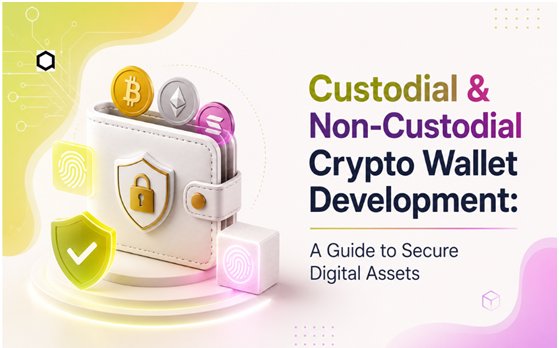
A cryptocurrency wallet is more than a storage application, it serves as the security gateway between users and blockchain networks.
Prelude
Hey everyone, Digital assets have evolved from being a niche investment to becoming an essential component of enterprise financial ecosystems. Financial institutions, cryptocurrency exchanges, payment providers, fintech startups, gaming platforms, and Web3 businesses are increasingly investing in secure wallet infrastructure to manage cryptocurrencies, tokenized assets, NFTs, and stablecoins.
However, choosing the right wallet architecture is no longer just about storing digital assets. Enterprises must decide whether a custodial or non-custodial wallet best aligns with their security, compliance, operational control, and user experience objectives.
While custodial wallets prioritize managed security and regulatory oversight, non-custodial wallets empower users with complete ownership of private keys. Selecting the right model directly impacts business scalability, transaction security, customer trust, and long-term operational efficiency.
This guide explores the architecture, advantages, limitations, and enterprise applications of both wallet models, helping businesses build secure digital asset infrastructure for the next generation of blockchain-powered services.
Why Wallet Infrastructure Matters?
A cryptocurrency wallet is more than a storage application, it serves as the security gateway between users and blockchain networks. Modern crypto wallet development focuses on building secure, scalable, and enterprise-ready infrastructure that enables persistent digital asset management across blockchain ecosystems.
Modern enterprise wallet infrastructure enables organizations to:
● Secure digital assets
● Process blockchain transactions
● Support multiple cryptocurrencies
● Enable tokenized asset management
● Integrate DeFi services
● Connect with Web3 applications
● Maintain regulatory compliance
● Reduce operational risk
As institutional adoption accelerates, crypto wallet development has become a critical competitive advantage, helping businesses deliver secure, compliant, and future-ready digital asset solutions.
Custodial Wallet Development
A custodial wallet stores users' private keys on secure enterprise-controlled servers.
Instead of managing cryptographic credentials themselves, users authenticate using conventional methods such as passwords, biometrics, or multi-factor authentication.
This model simplifies user onboarding while allowing businesses to enforce security policies, recovery procedures, and compliance requirements.
Enterprise Features
● Centralized key management
● Multi-layer authentication
● Transaction monitoring
● Fraud detection
● Account recovery
● Regulatory compliance
● Enterprise-grade encryption
● Permission-based access
Custodial wallets are commonly deployed by cryptocurrency exchanges, fintech platforms, digital banking applications, institutional investment firms, and payment providers.
Non-Custodial Wallet Development
Non-custodial wallets give users complete ownership of their private keys.
Private keys never leave the user's device, ensuring that only the wallet owner can authorize blockchain transactions.
This model aligns closely with blockchain's decentralized philosophy while providing maximum privacy and asset ownership.
Enterprise Features
● User-controlled private keys
● Local transaction signing
● Seed phrase recovery
● Multi-chain support
● Hardware wallet integration
● Web3 compatibility
● DeFi connectivity
● NFT management
Although security responsibility shifts to users, non-custodial wallets significantly reduce centralized attack surfaces.
Enterprise Comparison
|
Feature |
Custodial Wallet |
Non-Custodial Wallet |
|
Private Key Ownership |
Business |
User |
|
Asset Control |
Managed |
Fully User-Owned |
|
Recovery Options |
Available |
Recovery Phrase Only |
|
Regulatory Compliance |
High |
Moderate |
|
User Responsibility |
Low |
High |
|
Blockchain Freedom |
Moderate |
Complete |
|
Enterprise Monitoring |
Full |
Limited |
|
Best For |
Exchanges & Financial Platforms |
Web3 & DeFi Applications |
Enterprise Wallet Adoption by Industry
Enterprise Wallet Adoption by Industry, estimated adoption of enterprise-grade wallet infrastructure across major sectors.

Regardless of wallet type, enterprise infrastructure should incorporate multiple security layers.
These include:
● End-to-end encryption
● Hardware Security Modules (HSM)
● Multi-signature authorization
● Cold storage integration
● Secure key generation
● Device authentication
● Transaction risk analysis
● Address whitelisting
● Secure backup mechanisms
● Real-time monitoring
● API security controls
● Audit logging
A layered security architecture minimizes operational risks while improving compliance readiness.
Enterprise Decision Factors
|
Decision Factor |
Importance |
|
Security |
35% |
|
Regulatory Compliance |
25% |
|
User Experience |
20% |
|
Scalability |
12% |
|
Operational Cost |
8% |
This distribution can be visualized as a pie chart in your blog:
Real-World Example
A leading global cryptocurrency exchange operates primarily on a custodial wallet infrastructure, enabling millions of users to buy, sell, and transfer digital assets without directly managing private keys. This approach supports account recovery, compliance procedures, fraud monitoring, and high-volume transaction processing while simplifying the user experience.
In contrast, decentralized wallet applications such as browser-based Web3 wallets follow a non-custodial model, where users retain exclusive control over their private keys. This architecture enables direct interaction with decentralized applications, NFT marketplaces, and DeFi protocols without relying on a centralized intermediary.
These two approaches illustrate how wallet architecture is selected based on business objectives, regulatory requirements, and the desired balance between convenience and user ownership.
Choosing the Right Infrastructure
Custodial wallets are ideal for organizations requiring centralized governance, compliance, customer support, and operational oversight.
Non-custodial wallets are better suited for businesses prioritizing decentralization, user ownership, privacy, and direct blockchain interaction.
Many modern enterprises are also adopting hybrid wallet infrastructures, combining custodial services for institutional users with non-custodial options for Web3-native customers. This strategy delivers flexibility while addressing diverse market needs.
Conclusion
As digital assets become integral to enterprise finance, wallet infrastructure is emerging as the foundation of secure blockchain ecosystems. The decision between custodial and non-custodial wallet development extends beyond key management, it influences security, compliance, scalability, operational efficiency, and customer trust.
Organizations that invest in a well-designed wallet architecture today will be better positioned to support evolving blockchain applications, tokenized economies, cross-chain interoperability, and institutional digital asset management.
Whether deploying a custodial, non-custodial, or hybrid solution, enterprises should prioritize robust security, resilient infrastructure, and persistent user experiences to build a future-ready digital asset platform.
What's Your Reaction?