Seed Germinator: Removing All Doubts about Seed Tests
Seed germinator chambers provide controlled environmental conditions for seed germination, viability testing and agricultural research. These chambers regulate temperature and, depending on the selected configuration, humidity and lighting to support repeatable germination studies under laboratory conditions.
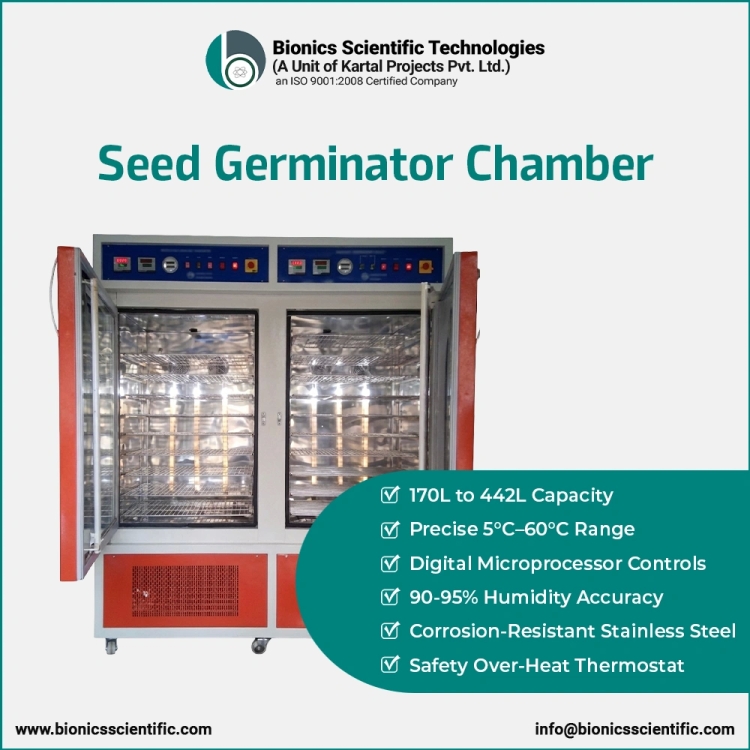
Every person who has experienced the frustration of waiting weeks to see if a batch of seeds can be successfully grown and then realizes the test has not been a reliable one knows the need to perform germination tests in a controlled environment. This is precisely what a seed germinator does.
True Purpose of a Seed Germinator
The #seedgerminator can be defined as a device whose main purpose is to provide the right conditions of temperature, humidity, and sometimes light to ensure that the seeds germinate effectively. Contrary to the use of the soil beds whose temperature and humidity tend to fluctuate and are also not consistent with the watering, this equipment ensures that the seeds get exposed to the same conditions for the whole period of the test. It is very vital in the quality germination tests since a small variation in temperature and humidity might give wrong results.
Environmental Variables It Controls
The first variable in all seed germinators is temperature because different species of plants have different temperatures for proper seed germination in a range from 20°C to 30°C, depending on the kind of seeds being grown. The level of humidity is another variable that is controlled alongside temperature because it should be kept at an optimum level so that the seeds can become softer and enzymes get activated but fungi do not develop inside because this will interfere with the results of the experiment. Sometimes, in more sophisticated germinators, there is also programmed lighting period because some seeds require light for germination.
The Need for Standardized Testing
Standardized tests are used in germination testing to determine the quality of the seed lots that will be sold to or distributed among the farmers. Germination tests ensure that there are certain standards that need to be met so that the results that are determined from the percentages of germination can be reliable. This is important as without standardized tests, the farmers purchasing the seed lots will not be able to trust their capacity to give viable crop yields.
The Need for Standardized Testing
Standardized tests are used in germination testing to determine the quality of the seed lots that will be sold to or distributed among the farmers. Germination tests ensure that there are certain standards that need to be met so that the results that are determined from the percentages of germination can be reliable. This is important as without standardized tests, the farmers purchasing the seed lots will not be able to trust their capacity to give viable crop yields.
Selection of the Proper Germinator Depending on the Testing Requirements
First of all, the organization should think about the size of the sample that should be tested, as well as the range of temperature and humidity accuracy required by the lab for testing different kinds of seeds. Now, digital monitoring along with data logging has become a key factor when selecting a proper germinator because it enables labs to monitor everything through recording.
Calibration is another key point to be considered because minor changes can influence the test outcomes.
Conclusion
While the germinator plays an unobtrusive part in the agricultural process of testing, the significance of its contribution in collecting data regarding the seeds' quality should not be ignored by farmers and seed producers.
FAQ – Seed Germinator
1. What is a Seed Germinator?
A Seed Germinator is a laboratory instrument designed to provide controlled environmental conditions for testing and studying seed germination. It helps maintain parameters such as temperature, humidity, light, and moisture according to the requirements of different seed-testing procedures.
2. What is the main purpose of a Seed Germinator?
The main purpose is to create stable and controlled conditions for seed germination tests. It is commonly used to evaluate germination percentage, seed viability, seedling development, and other characteristics related to seed quality.
3. How does a Seed Germinator work?
A Seed Germinator maintains preset environmental conditions inside an enclosed chamber. Temperature, humidity, and lighting can be controlled according to the test requirements, allowing seeds to germinate under repeatable laboratory conditions.
4. Why is controlled temperature important for seed germination?
Temperature can significantly affect the rate and uniformity of seed germination. A controlled-temperature environment helps maintain consistent testing conditions and reduces variations caused by changes in room temperature.
5. What types of seeds can be tested in a Seed Germinator?
Seed Germinators can be used for testing many types of agricultural, horticultural, vegetable, flower, and research seeds. The appropriate temperature, moisture, and light conditions depend on the specific seed species and testing method.
6. What temperature range is available in a Seed Germinator?
The operating temperature range varies according to the model and manufacturer. Different models are designed for different laboratory requirements, so the specified temperature range should be checked before selecting an instrument.
7. Does a Seed Germinator control humidity?
Many Seed Germinator models include humidity-control or humidity-maintenance features. Controlled humidity can help create suitable conditions for germination testing and maintain consistency between test cycles.
8. Does a Seed Germinator provide lighting?
Yes, many Seed Germinators are equipped with internal lighting systems. Programmable light and dark cycles may be available depending on the model and application.
9. Where is a Seed Germinator commonly used?
Seed Germinators are commonly used in seed-testing laboratories, agricultural research facilities, universities, colleges, plant science laboratories, horticultural research centers, and quality-control laboratories.
10. What are the advantages of using a Seed Germinator?
A Seed Germinator provides controlled and repeatable environmental conditions for seed testing. It can help improve test consistency, reduce environmental fluctuations, and support reliable evaluation of seed germination and seedling growth.
11. Can a Seed Germinator be used for research?
Yes. It can be used for agricultural and plant-science research involving seed germination, seed viability, seedling growth, temperature effects, light requirements, and other controlled-environment studies.
12. What factors should be considered when selecting a Seed Germinator?
Important factors include chamber capacity, temperature range, temperature uniformity, humidity control, lighting arrangement, programmable controls, energy efficiency, construction quality, safety features, and the specific requirements of the intended testing application.
13. Is temperature uniformity important in a Seed Germinator?
Yes. Good temperature uniformity helps ensure that samples placed at different positions inside the chamber experience similar conditions. This is important for obtaining consistent and reproducible test results.
14. Can the temperature and lighting cycle be programmed?
Depending on the model, programmable controllers may allow users to set temperature conditions and lighting cycles. Advanced models may provide additional programming and monitoring functions for different test requirements.
15. How is a Seed Germinator maintained?
Routine maintenance may include cleaning the chamber, checking temperature and humidity sensors, inspecting lighting components, maintaining water or humidification systems where applicable, and periodically verifying operating performance according to the manufacturer's recommendations.
16. Is a Seed Germinator suitable for seed quality testing?
Yes. Seed Germinators are widely used to provide controlled conditions for germination testing as part of seed-quality evaluation. Test procedures should follow the applicable laboratory methods or relevant standards.
17. What is the difference between a Seed Germinator and a standard laboratory incubator?
A Seed Germinator is specifically designed for applications involving seed germination and may provide features such as controlled lighting, humidity management, and programmable day/night cycles. A standard incubator may primarily focus on maintaining a controlled temperature.
18. Who can use a Seed Germinator?
Seed Germinators can be used by seed-testing laboratories, agricultural scientists, researchers, universities, plant breeders, horticultural laboratories, and quality-control professionals who need controlled conditions for germination-related studies.
What's Your Reaction?