How Burnishing Leather Changes the Look and Feel of Leather
The leather goods finishing process uses several leather treatment methods. Burnishing is frequently compared to painting, edging, and waxing. Each has a purpose, and the results are different.
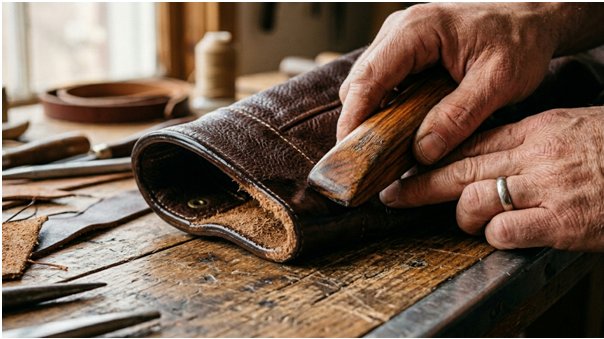
The edge of a leather jacket is unseen by most people. But that little strip of leather on the seam, the collar, or the cuff tells you all about how much care went into making it. The edges of burnished leather are smooth, sealed, and almost glass-like. Leather is raw and unburnished. It wears as it ages.
Burnishing is one of those finishing steps in leather that separates mass-produced goods from well-crafted ones. At Leather Jacket Black, we think it’s worth understanding, as it directly affects how your jacket will age, feel, and hold up.
So what is leather burnishing, anyway?
Leather burnishing is a leather surface treatment that involves the use of friction and pressure on the edge or surface of leather to compress the fibers and seal in moisture, creating a polished finish. This is part of the post-tanning process on leather that gives finished leather goods their look and longevity.
This process can be done by hand with a wood slicker or bone folder or mechanically with a rotating burnishing wheel. In either case, the objective is the same: to compact the loose fibers at the edge of the leather so they will not fray, absorb dirt, or weaken over time.
Important facts to know:
● Burnishing compresses the leather fibers up to 60%, creating a denser, more durable edge
● Properly burnished edges can extend the life of leather goods by 30-40% in high wear areas
● Vegetable-tanned leather is best for burnishing because of its dense, tight fiber structure
● Leather crafting is a centuries-old technique and is a staple of saddle making and bookbinding
How it affect the look of leather
You can see the difference visually. The raw edge of a cut piece of leather is fuzzy and irregular. But that same edge after burnishing looks sealed, smooth, and intentional. It gives the piece a professional, finished look that you can see from the other side of a room.
Upon first look, burnishing produces a delicate sheen. Properly applied, it enhances the natural color of the leather and brings out the grain in a way that paint or wax alone cannot. This is part of the reason why different types of leather finishes look so different when they are finished. Burnished leather has a depth that coated finishes often lack.
Visual changes you will see:
● Edges are smooth and sealed instead of fuzzy and raw.
● Surface color slightly darker and more uniform
● Visible grain texture, more defined
● The piece as a whole feels more finished and purposeful
How It Changes Leather Feel
The tactile difference is just as striking. Edges unburnished are coarse. If you run your finger along the edge of a cheaply made leather jacket, you will often snag on loose fibers. A well-burnished edge is almost glassy, perfectly smooth to the finger.
Burnishing also affects the surface feel by compressing the top layer of fibers. This makes the leather feel firmer and denser, which is actually a good thing. Firmer leather holds its shape better, resists creasing in the wrong places, and breaks in more gracefully over time.
Changes to the tactile after burnishing:
● Edges should feel smooth and sealed, not rough or scratchy
● Surface has a slightly heavier, denser hand feel
● Leather retains its shape better when worn
● Fibers are already compressed, so the break-in period is smoother

Burnishing vs. Other Surface Treatments on Leather

The leather goods finishing process uses several leather treatment methods. Burnishing is frequently compared to painting, edging, and waxing. Each has a purpose, and the results are different.
A brief comparison of the standard finishing methods:
● Burnishing is a mechanical compression of the fibers; no coating is added, has a very natural look, and it works best on veg-tan leather
● Edge paint – adds a layer of color to the edge, seals it, but can crack or peel over time
● Waxing adds a protective wax coating, good for moisture resistance, but adds material rather than working with the fiber
● Tokonole / CMC are water-based burnishing agents used frequently before or during the burnishing process to aid in fiber compression
For a complete breakdown of what burnishing is, how it differs from other finishing methods, etc., check out the leather burnishing guide on Leather Jacket Black.
Why it’s Important for Leather Jackets Specifically
Leather jackets are worn out. The collar edges flex as you turn your neck. Sleeve cuffs are constantly being pulled on and pushed up. The edges of zipper tape rub against skin and fabric. These are high-wear areas, and it’s also where unfinished leather wears out the fastest.
At Leather Jacket Black, we give our jackets a proper leather goods finishing process, including edge burnishing at each major stress point. It is not just about aesthetics. It's a question of structural integrity. The burnished edge is more resistant to abrasion, less prone to cracking from repeated flexing, and holds its shape over years of wear.
Why it’s important to burnish jackets:
● The first thing to wear on the collar and cuffs is the edges, and burnishing slows this down considerably
● Pocket edges stay sharp and tidy, not fraying out over time
● Seam edges on the inside of the jacket will not irritate or scratch skin
● The jacket wears more evenly and develops a uniform patina
The Bottom Line
Burnishing is not a cosmetic detail. It is a structural part of how leather is finished, and it directly affects how your jacket looks, feels, and ages. The difference between a jacket with properly burnished edges and one without is not always obvious on day one. But after a year of wear, it becomes very clear.
At Leather Jacket Black, we build jackets that are meant to last. That means not cutting corners on the steps that matter most, including leather surface treatment done right.
FAQs on Leather Burnishing
Will burnishing work on every kind of leather?
Not quite. The best leather for this purpose is vegetable tanned, with a tighter fibre structure. Most of the mass-market jackets are made of chrome-tanned leather, which is harder to burnish properly and often needs edge paint instead.
Can you polish a leather jacket at home?
You can do a little bit of edge touch-up with a bone folder and some Tokonole or water, but *real* surface burnishing requires the right tools. Best left to the professionals, unless you are experienced in leather crafting techniques for a jacket.
How do I know if my jacket is correctly burnished?
Run your fingertip around the edge of the collar, the cuffs, the pocket openings. If they feel smooth and consistent with no rough patches or loose threads then the leather finishing process was done correctly. If you can feel the edges or catch the fibers, it was skipped or done poorly.
Does burnishing change the way a jacket breaks in?
Yes. Because the fibers are already compressed, burnished leather tends to break in more evenly. You get a smoother transition from stiff to supple without the awkward uneven softening that happens with improperly finished leather.
Is burnishing the same as polishing leather?
Not quite. Polishing usually adds product to the surface. Burnishing is done by friction and pressure from the leather itself. Both improve appearance, but burnishing changes the structure of the leather, not just the surface.
What's Your Reaction?