Custom API Development vs Prebuilt Integrations: Which One Is Best for Your Business
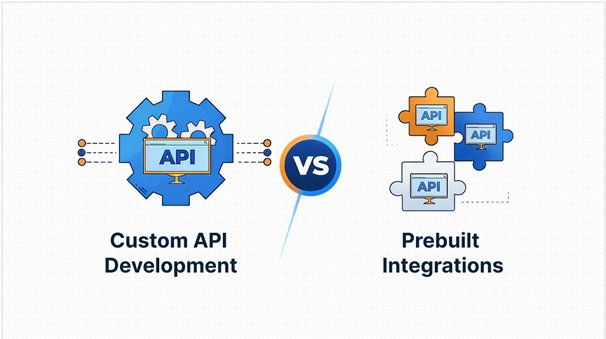
The choice between prebuilt integrations and custom API development comes down to how much flexibility, control, and scalability your business needs.
Integrations play a direct role in how fast a business can move, how reliably data flows between systems, and how well technology supports growth. This is where many organizations get stuck.
The market is full of “quick integrations” that promise fast setup, but not all integrations are built to scale. As systems evolve and complexity increases, the gap between short-term convenience and long-term reliability becomes hard to ignore.
This leads to a common question: should you rely on prebuilt integrations, or is it time to invest in a more tailored approach?
For many growing businesses, custom API development emerges as a strategic solution that prioritizes flexibility, control, and scalability.
In this article, we’ll break down both approaches clearly and objectively.
You’ll learn:
● How does each option work?
● Where do they fit best?
● How do you choose the right integration strategy based on your business needs?
By the end, you’ll have a practical framework to decide which one will work for your business.
What Are Prebuilt Integrations?
Prebuilt integrations are ready-made connections provided by software vendors or third-party platforms. These often come in the form of connectors, plugins, or native integrations that link two systems with minimal setup.
They typically fit well in a tech stack when use cases are standard and requirements are predictable.
Advantages of Prebuilt Integrations
● Faster setup with minimal configuration
Prebuilt integrations are ready to use, allowing teams to connect systems quickly without lengthy development cycles.
● Lower initial effort and cost
Since these integrations are already built and maintained by vendors, businesses avoid upfront development investment.
● Minimal technical expertise required
Most prebuilt tools are designed for non-technical users, making them accessible to teams without dedicated engineering resources.
● Well-suited for standard, predictable use cases
When business processes closely match the integration’s default behavior, prebuilt solutions can work reliably.
Common Use Cases for Prebuilt Integrations
Prebuilt integrations are well-suited for scenarios like simple CRM-to-email synchronization, where basic contact data needs to flow between systems without complex logic or real-time dependencies.
They also work well with off-the-shelf SaaS tools that have limited customization needs, such as connecting a helpdesk tool to a CRM or syncing leads between a form builder and a marketing platform.
Limitations of Prebuilt Integrations at Scale
While prebuilt integrations offer quick wins early on, their limitations become increasingly apparent as systems grow and business requirements evolve.
● Limited flexibility and customization
Prebuilt integrations are designed around generic use cases. When business logic deviates from those assumptions, customization options are often limited or unavailable.
● Dependency on vendor roadmaps and updates
Businesses are constrained by how and when vendors choose to update integrations. Critical changes or fixes may be delayed, or never delivered in some cases.
● Difficulty supporting complex workflows
Advanced logic, conditional processes, or multi-system orchestration often fall outside the capabilities of prebuilt connectors.
What Is Custom API Development?
Custom API development is about building integrations around your specific business logic and workflows. Instead of adapting processes to fit a connector’s limitations, custom APIs are designed to reflect how data should move, transform, and trigger actions across systems in your environment.
It allows businesses to define how systems interact today while remaining flexible enough to adapt as requirements change.
Benefits of Custom API Development for Growing Businesses
As businesses scale, integrations need to adapt, perform, and grow alongside the organization.
This is where custom API development delivers long-term value.
● Flexibility and Control
Custom APIs are built around your specific data models, workflows, and business logic. This gives teams full control over how systems communicate and evolve, without being constrained by third-party limitations or vendor roadmaps.
● Better Performance and Real-Time Data Flow
With custom API development, integrations can be designed for real-time or event-driven data exchange. This reduces latency, eliminates unnecessary polling, and ensures systems stay synchronized as actions occur.
● Scalability and Future Readiness
Custom APIs are designed for growth and scalability. New systems, regions, or partners can be added without reworking existing integrations. By avoiding tightly coupled connectors and one-off fixes, businesses reduce integration debt and build an architecture that remains stable and adaptable as complexity increases.
Key Factors to Consider Before Final Selection
Choosing between custom API development and prebuilt integrations depends on several business-specific factors. Evaluating these areas helps choose the right integration approach.
Business complexity and growth plans
Consider how complex your workflows are today and how much they are expected to evolve. Rapid growth, expansion into new markets, or changing business models often require more flexible, scalable integration approaches.
Number of systems and integrations
The more platforms you rely on, the harder it becomes to manage point-to-point connections. A growing integration landscape typically benefits from a more structured, API-driven strategy.
Data criticality and real-time needs
If your operations depend on accurate, real-time data (such as inventory updates, customer actions, or financial transactions), basic syncing may not be sufficient. Here, integration reliability becomes essential.
Compliance and security requirements
Regulatory obligations, data privacy rules, and security standards can influence integration design. Custom APIs allow greater control over access, validation, and auditability compared to generic connectors.
Choosing the Right Integration Strategy for Your Business
The right strategy depends on how your business operates today, and how it plans to evolve over time.
This is why architecture planning and discovery are so important. Taking the time to understand your systems, data flows, dependencies, and future requirements helps avoid short-term fixes that turn into long-term constraints.
A thoughtful integration architecture provides clarity on where prebuilt tools make sense and where custom APIs are necessary to support flexibility and scale.
Most importantly, integration decisions should look beyond “today’s problem.” It’s easy to choose the fastest solution for immediate needs, but that approach often leads to technical debt and limited scalability.
A future-focused strategy considers growth, ensuring your integration approach continues to support the business rather than restrict it.
Conclusion
The choice between prebuilt integrations and custom API development comes down to how much flexibility, control, and scalability your business needs.
Prebuilt integrations offer speed and simplicity for standard use cases, while custom APIs provide the adaptability and performance required for complex, evolving environments.
Understanding these core differences is crucial for making informed long-term decisions.
What's Your Reaction?