What is a Planetary Ball Mill?
Planetary ball mills are used for the pulverization of soft, hard, brittle, and fibrous materials in dry and wet mode.
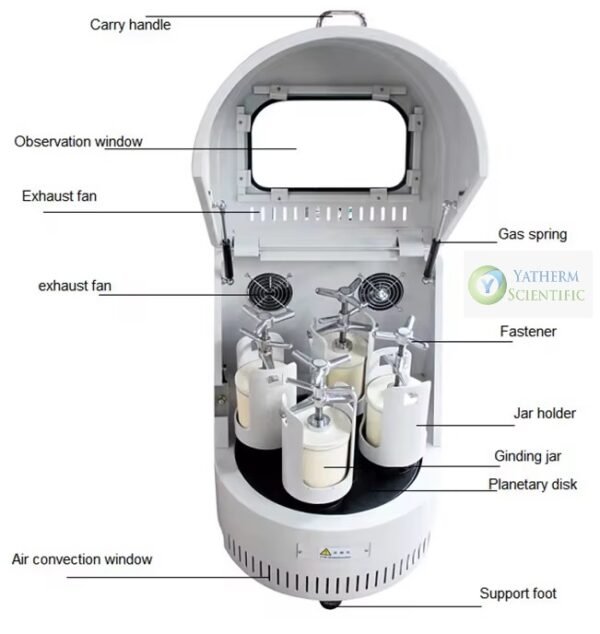
A Planetary Ball Mill is a high-energy grinding machine used to reduce materials into extremely fine powders. It is widely used in laboratories and industries for mixing, homogenizing, and mechanical alloying.
Unlike traditional grinding equipment, a planetary ball mill operates using a unique dual-motion system:
- The grinding jars rotate on their own axis
- At the same time, they revolve around a central axis
This combined motion creates intense grinding forces, making it possible to achieve particle sizes at the micro and even nano level.
In simple terms:
It’s a machine that uses controlled chaos—motion, impact, and friction—to transform materials into something entirely new.
Chapter 3: The Working Principle – A Dance of Forces
To truly understand a planetary ball mill, you need to imagine what’s happening inside those jars.
Each jar contains:
- The material to be ground
- Grinding balls (made of steel, ceramic, or other materials)
When the machine starts, the jars spin rapidly. But here’s the magic:
Dual Rotation System
- The jar rotates in one direction
- The supporting disk rotates in the opposite direction
This creates extremely high centrifugal forces.
Impact and Friction
Inside the jar:
- Grinding balls collide with the material
- The material gets crushed through impact
- Continuous friction further refines the particles
The result?
Ultra-fine, uniform powder in a surprisingly short amount of time.
Why It’s So Powerful
The key lies in energy.
Compared to conventional ball mills, planetary ball mills generate significantly higher energy levels due to their unique motion. This allows them to:
- Break down hard materials
- Achieve nano-sized particles
- Mix materials at a molecular level
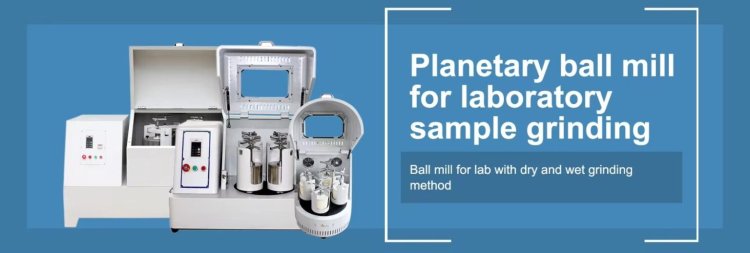
Chapter 4: Components That Make It Work
Behind this powerful process is a carefully designed system.
1. Grinding Jars
These are the containers where the material and balls are placed. They come in various sizes and materials depending on the application.
2. Grinding Balls
The heart of the process. These balls create the impact and friction needed for grinding.
Materials include:
- Stainless steel
- Zirconia
- Tungsten carbide
3. Rotating Platform (Sun Wheel)
This is the central disk that drives the jars in a planetary motion.
4. Motor System
Provides the power needed for high-speed rotation.
5. Control Panel
Modern machines come with digital controls for:
- Speed adjustment
- Time settings
- Direction control
Chapter 5: Types of Planetary Ball Mills
Different industries require different configurations.
1. Laboratory Planetary Ball Mills
- Compact and precise
- Used in research labs and universities
2. Industrial Planetary Ball Mills
- Larger capacity
- Designed for mass production
3. High-Energy Planetary Ball Mills
- Designed for extreme grinding conditions
- Used for advanced material synthesis
4. Vertical and Horizontal Models
- Vertical models save space
- Horizontal models may offer better stability
Chapter 6: Applications Across the United States
Let’s step out of the lab and into real-world industries.
1. Battery Manufacturing (The EV Revolution)
With electric vehicles booming across the U.S., planetary ball mills play a crucial role in:
- Preparing lithium-ion battery materials
- Achieving uniform particle size
- Enhancing battery performance
From Tesla factories to emerging startups, these machines are part of the clean energy future.
2. Pharmaceutical Industry
In pharmaceutical labs:
- Active ingredients are finely ground
- Uniform mixing ensures consistent dosage
- Drug effectiveness is improved
Precision here isn’t optional—it’s life-saving.
3. Nanotechnology and Advanced Materials
Planetary ball mills are essential for:
- Producing nanoparticles
- Creating new alloys
- Developing advanced coatings
4. Ceramics and Glass Industry
Used for:
- Grinding raw materials
- Producing fine ceramic powders
- Improving product strength and finish
5. Aerospace and Defense
In high-tech manufacturing:
- Lightweight materials are developed
- High-strength alloys are processed
These industries demand perfection—and planetary ball mills deliver.
6. Food and Chemical Processing
Even in food and chemical sectors:
- Fine powders are produced
- Ingredients are uniformly mixed
Chapter 7: Advantages of Planetary Ball Mills
Why are these machines so widely used?
1. Ultra-Fine Grinding
Achieves particle sizes down to nanometers.
2. High Efficiency
Faster processing compared to traditional mills.
3. Versatility
Can handle a wide range of materials.
4. Uniform Mixing
Ensures consistent results across batches.
5. Compact Design
Ideal for laboratories with limited space.
Chapter 8: Challenges and Considerations
No machine is perfect, and planetary ball mills come with their own challenges.
1. Heat Generation
High energy can lead to temperature rise, affecting sensitive materials.
2. Wear and Tear
Grinding balls and jars need regular replacement.
3. Noise and Vibration
High-speed operation can generate noise.
4. Cost
Advanced models can be expensive, especially for small labs.
Chapter 9: Safety Measures
In U.S. labs and industries, safety is a top priority.
Key precautions include:
- Proper sealing of jars
- Using protective equipment
- Monitoring temperature and pressure
- Regular maintenance
Chapter 10: The Future of Planetary Ball Mills
The future is spinning faster than ever.
1. Smart Automation
AI-driven systems for optimized grinding.
2. Energy Efficiency
Reduced power consumption without compromising performance.
3. Advanced Materials Processing
Supporting innovations in nanotech and renewable energy.
4. Integration with Digital Labs
Connected systems for real-time monitoring and control.
Chapter 11: Choosing the Right Planetary Ball Mill
If you’re considering one, here’s what matters:
- Material type
- Desired particle size
- Capacity requirements
- Budget
- Industry standards
A well-chosen machine can transform your entire workflow.
Chapter 12: A Machine That Mirrors the Universe
There’s something poetic about a planetary ball mill.
It mimics the motion of planets, harnesses invisible forces, and transforms raw materials into something refined and powerful.
It reminds us that even in the smallest spaces—inside a rotating jar—entire worlds of change can exist.
Conclusion: The Power of Controlled Motion
The planetary ball mill is more than just a grinding machine. It’s a symbol of how controlled motion and precision engineering can unlock new possibilities.
Across the United States, from research labs to manufacturing plants, it continues to play a vital role in shaping the future of materials, energy, and technology.
It works quietly, spins endlessly, and delivers results that power industries and innovations.
In a way, it’s not just grinding materials.
It’s shaping the future—one particle at a time.
Frequently Asked Questions (FAQs)
1. What is a planetary ball mill used for?
It is used for grinding, mixing, and reducing materials into ultra-fine powders, often at micro or nano levels.
2. How does a planetary ball mill work?
It uses dual rotation—jars rotate on their own axis while revolving around a central axis—creating high-energy impact and friction.
3. What materials can be processed?
Metals, ceramics, chemicals, pharmaceuticals, and even food materials can be processed.
4. What is the difference between a ball mill and a planetary ball mill?
A planetary ball mill generates much higher energy due to its dual-motion system, resulting in finer particles.
5. Can it produce nanoparticles?
Yes, it is widely used for producing nano-sized particles in advanced research.
6. Is it suitable for industrial use?
Yes, both laboratory and industrial models are available.
7. What are grinding balls made of?
They can be made of steel, ceramic, zirconia, or tungsten carbide, depending on the application.
8. Is it safe to use?
Yes, when proper safety measures and operating procedures are followed.
9. How long does grinding take?
It depends on the material and desired particle size, ranging from minutes to several hours.
10. Why is it called a planetary ball mill?
Because the motion of the jars resembles the orbit of planets around the sun.
What's Your Reaction?