The Art and Craft of Woven Leather: History, Process, and Why It Lasts
The key distinction in the current market is between genuine woven leather made from strips of real tanned hide and bonded or composite materials marketed using similar language.
Some materials exist because of innovation, and there are materials that exist because people discovered a combination that simply worked and kept returning to it for centuries. Woven leather is the second kind. It predates mass manufacturing, predates industrial tanning, and predates most of the other techniques we associate with quality leather goods. Its continued presence in high-end furniture, interior design, and artisan craft isn't nostalgia; it's a recognition that the material does things other materials don't.
Understanding where woven leather comes from, how it's made, and what makes it last helps you make better decisions about buying, using, and caring for it. This is the background.
A Brief History of Woven Leather
The practice of weaving leather strips predates written records in most cultures. Archaeological evidence of leather weaving, typically in the form of preserved fragments, has been found in ancient Egypt, across pre-Columbian South America, and in early European settlements. The basic principle is universal: thin strips of leather woven together create a material that is stronger and more flexible than either a solid panel or the individual strips alone.
For most of this history, woven leather was a practical material first and an aesthetic material second. Woven leather sandal soles were more durable than cut soles. Woven leather seating panels on early chairs and stools allowed air circulation and distributed weight more evenly than solid materials. Woven leather handles on baskets and tools were more comfortable to grip than rope or cord.
The aesthetic dimension, the recognition that the woven pattern itself was attractive, worth displaying rather than concealing, developed later, as tanning methods improved and leather quality became consistent enough to produce strips that were uniform in width, thickness, and color. By the medieval period, woven leather was appearing in luxury goods in Europe and across the Islamic world as a deliberate design choice, not just a structural solution.
The transition to the modern period brought mechanization to leather production but kept woven leather as a handicraft category. You cannot efficiently automate the weaving of leather strips in the same way you can automate cutting or splitting. The process requires human hands at the weaving stage, which is part of why quality woven leather goods have maintained their premium positioning. The labor content is genuinely higher than mass-produced alternatives.
How Woven Leather Is Made
The starting point is a tanned hide. The quality of the base hide determines the quality of the finished woven material. Strip width consistency, surface uniformity, and long-term durability all depend on starting with well-tanned, properly finished leather. Vegetable tanned hides are common for woven leather because of their firmness and the way they respond to conditioning over time. Chrome-tanned hides are used where more pliability is needed.
The hide is cut into strips using a hand-held or bench-mounted strap cutter — a tool with a fixed-width guide that produces consistent strip widths across a long cut. For high-quality woven leather, the strips are also skived to a consistent thickness, which affects how the weave lies flat and how the intersection points behave under use.
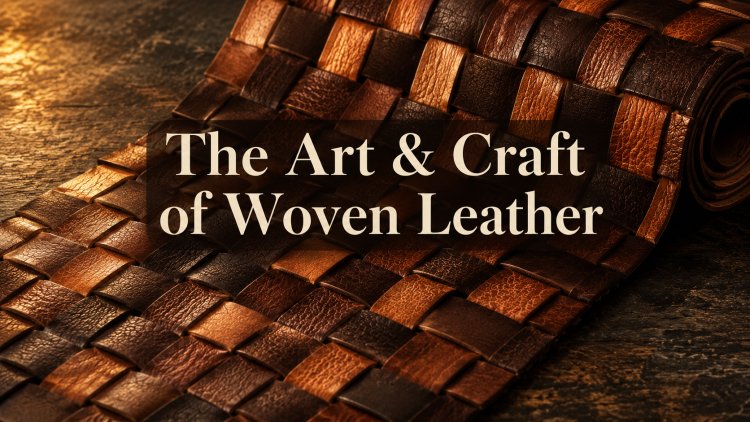
The actual weaving is done on a flat surface or a frame, with strips running in two perpendicular directions. In a standard basket weave, each strip passes alternately over and under the strips running perpendicular to it, and each subsequent strip reverses this pattern. The result is an interlocked structure where each strip is held in place by the strips running across it.
Once the panel is woven, the edges are secured by stitching, by backing, or by folding and bonding the strip ends, and the piece is finished with conditioning and any surface treatment appropriate to its intended application. The whole process, for a skilled craftsperson, produces a material that is genuinely hand-made in a meaningful sense: the specific arrangement of every strip reflects human judgment and craft skill.
Why Woven Leather Lasts
The structural advantage of woven leather is load distribution. In a solid leather panel, stress concentrates at weak points, thin spots in the hide, areas near seams, and sections where the grain is interrupted. In a woven panel, any force applied to the surface is distributed across multiple strips and multiple intersection points. A single strip can be damaged without compromising the overall panel, because the surrounding strips continue to carry the load.
This is the same principle that makes woven textiles stronger than their individual fibers, and it's why woven leather has historically been used in applications where durability under sustained mechanical stress matters. Chair seats, saddle panels, luggage surfaces, and floor rugs are all applications where the woven structure's load-distributing property extends the useful life of the material significantly.
The second longevity factor is leather's response to use. Genuine leather develops a patina with age, and handling the surface darkens, smooths slightly, and becomes richer in appearance. This is particularly visible in woven leather because the alternating grain-side and flesh-side exposure creates a two-tone surface that deepens and becomes more complex with time. Woven leather goods that are twenty or thirty years old, properly maintained, are typically more visually interesting than they were new.
What to Look for When Buying Woven Leather Today
The key distinction in the current market is between genuine woven leather made from strips of real tanned hide and bonded or composite materials marketed using similar language. Bonded leather is made from leather scraps ground into a pulp and bonded with adhesive to a backing material. It looks like leather initially and is significantly cheaper, but it delaminates and cracks within a few years of use. Genuine woven leather will not delaminate because there is no bonded composite layer; the material integrity is structural, held together by the weave itself.
When evaluating a woven leather product, look for the two-tone grain-to-flesh contrast that genuine weaving produces. In bonded leather panels with printed weave patterns, the surface is uniform, the 'strips' are part of the surface texture rather than genuine separate elements. In real woven leather, you can see and feel the individual strip edges at the intersections.
For buyers who want to see what genuine woven leather looks like and understand the material specifications behind it, ELeatherHub's woven leather collection provides clear product information that helps distinguish material quality, useful whether you're buying for a craft project, an interior application, or to understand what you're comparing against in the broader market.
The broader selection available at ELeatherHub also gives context for how woven leather compares to other leather categories in terms of weight, tanning method, and application range.
Conclusion
Woven leather has lasted this long because the combination of structural ingenuity and material quality produces results that alternatives haven't been able to improve on in any meaningful way. Synthetic weaves don't develop patina. Bonded leather doesn't distribute load across a woven structure. Textile rugs don't clean with a wipe and get more attractive with age. The history of the material is essentially the history of a solution that keeps proving itself in new contexts, which is a more reliable indicator of genuine quality than any marketing claim.
What's Your Reaction?